February 4, 2026
.jpg)



Rebate maturity is not just about better tools. It is about building the structure, visibility, and discipline needed to turn complex rebate programs into scalable profit protection.
In Brief
Rebate challenges almost never show up as obvious failures. From an executive vantage point, claims keep moving, accruals reconcile at a summary level, and distributor relationships remain largely intact. On paper, things appear handled.
But when you slow the conversation down and trace what actually happens after the sale—how contracts translate into transactions, how eligibility is enforced, how claims are validated, and how accruals are built—a different picture often emerges.
What surfaces isn’t dysfunction. It’s drift. Programs evolve, commercial complexity increases, and the operational foundation underneath them struggles to keep pace.
That gap is what the Rebate Maturity Model is designed to make visible. It did not come from theory or benchmarking exercises. It emerged from repeatedly following real rebate data through real systems and asking practical questions leaders care about:
For executives, this model creates clarity. For operators, it creates language.

Most organizations don’t struggle because they lack expertise or intent. They struggle because rebate strategies have become far more sophisticated than the environments executing them. Tiered programs, conditional incentives, customer- and product-specific logic, and overlapping agreements all make sense commercially. But without corresponding maturity in data, process, and systems, control becomes selective rather than systemic.
That’s when uncertainty creeps into leadership conversations.
Validation shifts from being routine to being sampled. Judgment fills gaps where enforceable logic doesn’t exist. Accruals rely more heavily on estimates. Disputes repeat familiar patterns.
Over time, leaders lose confidence in their ability to explain where margin is going and why.
For practitioners, this shows up as rework, exceptions, and recurring debates. For executives, it shows up as risk without a clean line of sight.
The maturity model provides a shared diagnostic—one that allows both groups to talk about the same reality without talking past each other.
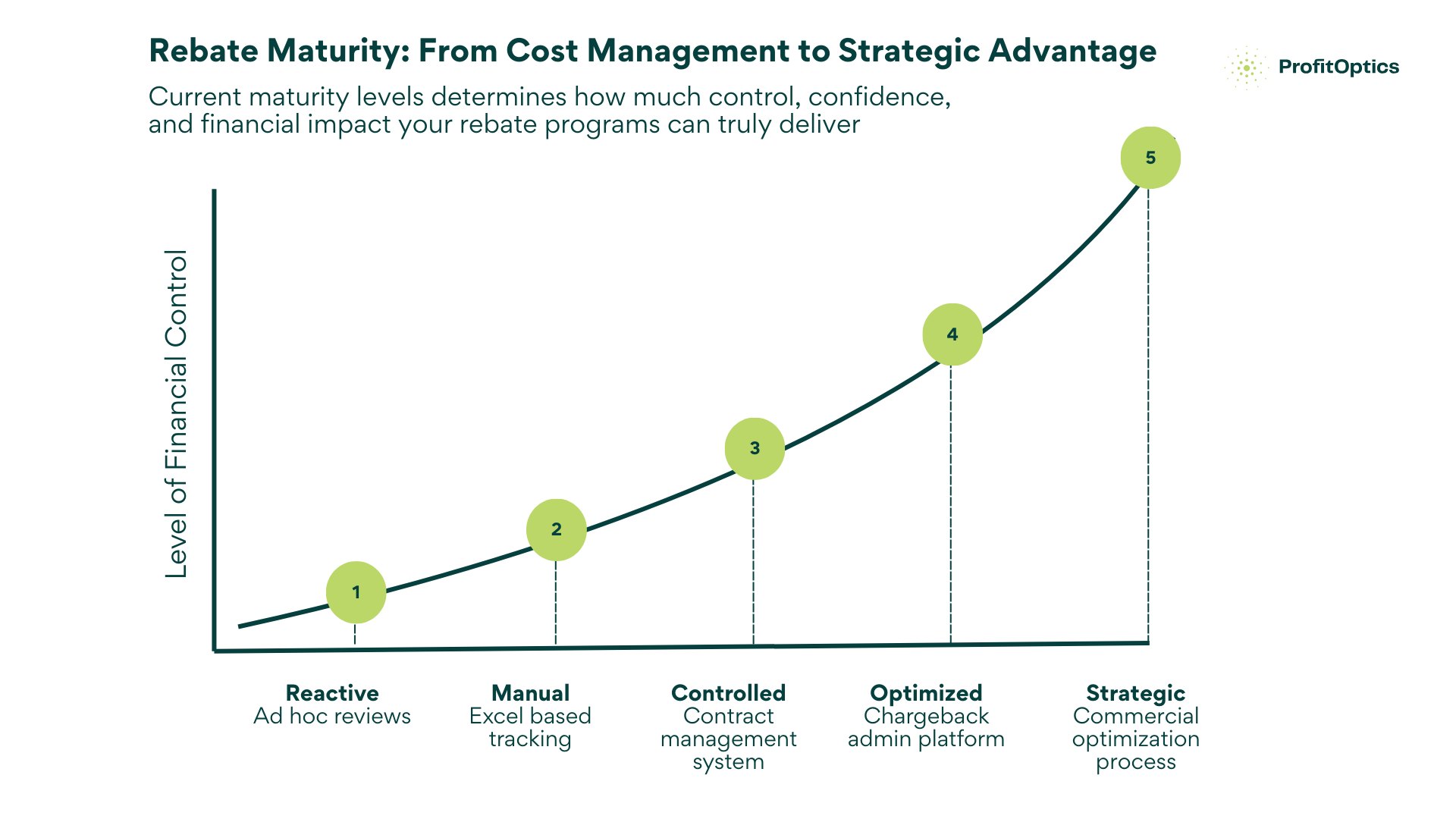
Organizations rarely sit cleanly in just one stage. Most operate across several at the same time, depending on program size, partner mix, and historical investment. The value of the model is not in labeling the organization, but in clarifying where control is strong, where it depends on effort, and where risk scales faster than visibility.
Rebates are processed, not managed.
Claims are handled as they arrive. Validation occurs when something looks wrong. Knowledge about program rules and exceptions often lives in people’s heads rather than in systems. Issues surface after the fact, making root causes hard to isolate and exposure difficult to quantify. Leadership typically becomes involved only when a problem escalates.
Control exists, but it doesn’t scale.
Structure begins to appear. Reviews become more formal. Spreadsheets grow more complex. Dedicated resources validate claims and reconcile accruals. While visibility improves, control remains effort-based. Judgment and institutional knowledge compensate for gaps, creating fragility as volume and complexity increase. Smaller programs and edge cases often receive less scrutiny.
Rules become enforceable and visibility becomes defensible.
Eligibility logic is formalized and executable. Transactions can be traced cleanly to contracts and pricing conditions. Validation is consistent rather than interpretive. Teams can explain not just that a claim is wrong, but why, using shared evidence. Overpayments decline, disputes are easier to resolve, and accrual confidence improves materially. Leadership gains a clearer, more defensible view of exposure.
Visibility turns into insight.
With reliable foundations in place, the focus shifts from validation to understanding. Patterns replace anecdotes. Teams analyze which programs create friction, where incentives misalign with behavior, and how rebate spend performs relative to margin. Operational effort decreases as processes become more predictable and repeatable, freeing time for analysis rather than cleanup.
Rebates become a commercial lever, not just a liability.
Rebate data informs decision-making before programs launch, not only after claims settle. Leaders model scenarios, refine incentives deliberately, and align rebate spend with growth and margin objectives. At this level, rebates actively shape the go-to-market strategy rather than reacting to it. Control, insight, and scale reinforce one another.
The Rebate Maturity Model is not about reaching the highest level everywhere. Very few organizations need—or benefit from—that. Its real value is diagnostic. It helps leadership teams see where maturity gaps intersect with high volume, high margin impact, or persistent friction.
Instead of debating whether rebate management is “working,” the conversation becomes more precise: Where is control sufficient? Where is it fragile? And where does improvement actually matter?
For practitioners, the model provides cover to raise systemic issues. For executives, it provides a way to prioritize without overcorrecting.

Across organizations, one pattern is consistent: control improves when validation replaces assumption. Not by adding more reviews, but by strengthening the foundations that allow rules to be enforced and data to be trusted.
That philosophy underpins the work we do at ProfitOptics. We approach rebates not as an administrative function or a software problem, but as a commercial system—one that can only be understood by observing how strategy, data, and execution interact in practice.
The maturity model supports that shift. It helps organizations move from reacting to issues, to enforcing rules, to using rebate insight as a source of leverage rather than uncertainty.
If this framework resonates, the most productive next step is often a conversation—not a demo or a pitch, but a working discussion. We regularly meet with executive and operating teams to compare notes, pressure-test assumptions, and discuss how rebate maturity tends to manifest across different programs and partners.
If it would be useful to explore how this model applies in your environment, the ProfitOptics team is always open to a thoughtful conversation.