July 17, 2026
.jpg)



Rebates and incentives are an important contributor to distributor profitability. Yet they're often some of the least visible parts of the business. The data needed to manage them effectively is often spread across contracts, spreadsheets, ERP systems, supplier portals, and email threads.
On the surface, everything appears to be working. Quarterly rebate checks arrive, accruals are recorded, and reports are submitted. Finance closes the books. But when you take a closer look, a different picture often emerges.
Some programs are actively managed and closely tracked. Others depend on spreadsheets, manual calculations, or the knowledge of a handful of employees. High-volume supplier agreements may receive significant attention, while smaller programs operate in the background.
Distributors don’t lack capable people. In fact, we routinely see very experienced teams working hard to keep complex rebate programs running. But rebate complexity often grows faster than the systems and processes used to manage it.
And because many rebate programs are calculated and settled months after the terms are defined, differences in contract language interpretation and calculation logic can chip away at the margin the program is expected to generate.
This report is designed to help you answer a simple question:
I’ve found most distributors don’t know. The good news is that most distributors don't need to reinvent rebate management from scratch. In many cases, the biggest gains come from improving visibility, automating processes, and connecting information that already exists across the business.
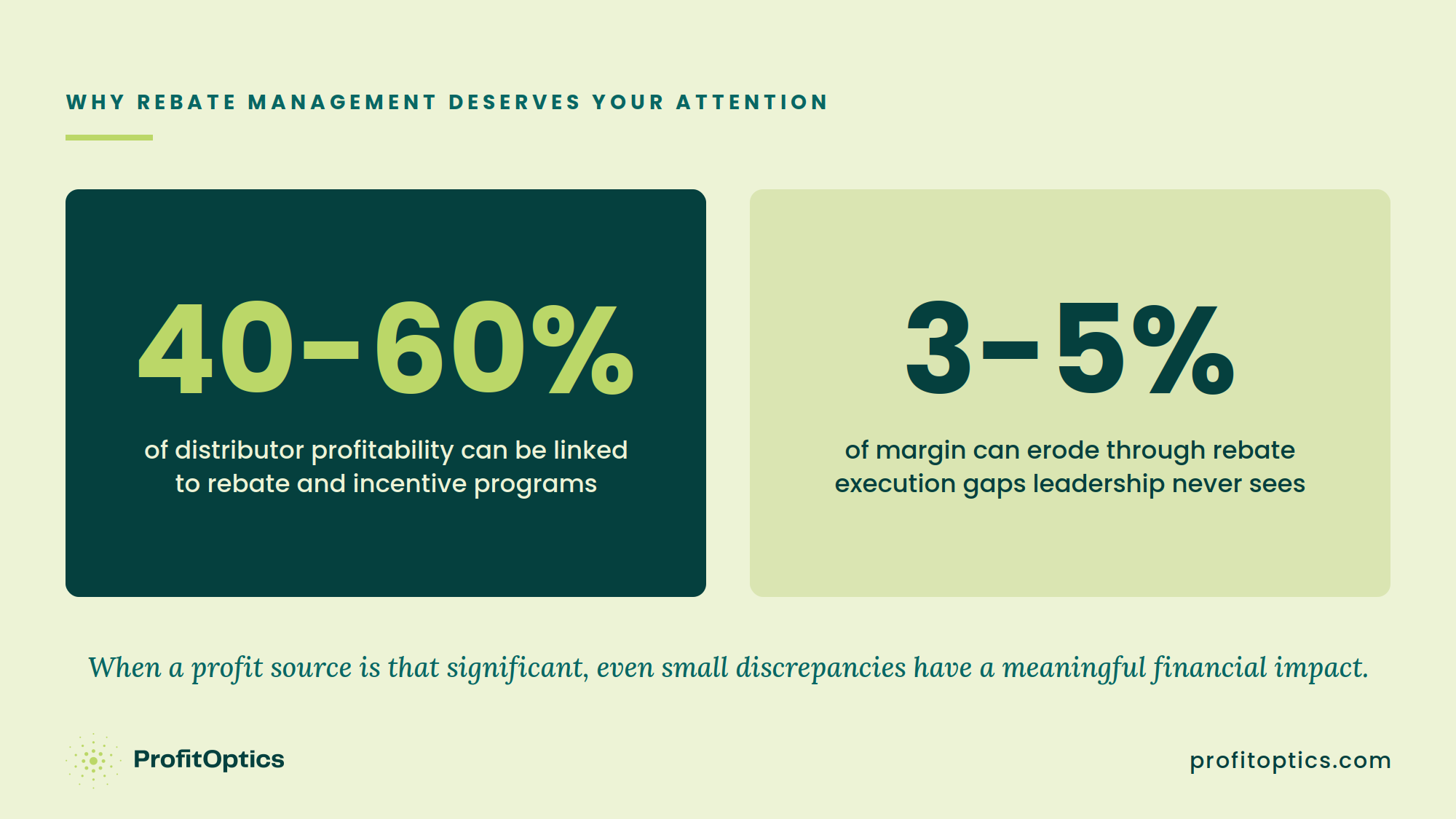
Some distributors attribute 40% to 60% of their profitability to rebate and incentive programs. When a profit source becomes that significant, even small discrepancies can have a meaningful financial impact. We've seen rebate execution gaps erode 3%-5% of margin, creating leakage leadership often has no visibility into.
Those losses show up as missed opportunities, delayed claims, inaccurate calculations, underperforming supplier programs, and decisions made without a complete picture of rebate performance.
While rebate programs have become more complicated over the past decade, the path to improving them hasn’t changed. Distributors that perform well almost always start by building a solid foundation, clearly defining contract terms and building a structured library of agreements before tackling automation or optimization.
That can be challenging.
Agreements live in one place, and sales transactions somewhere else. Customer programs, SPAs, volume incentives, accruals, and claims often sit in different systems. Teams rely on spreadsheets, supplier portals, ERP reports, emails, and institutional knowledge to connect the dots.
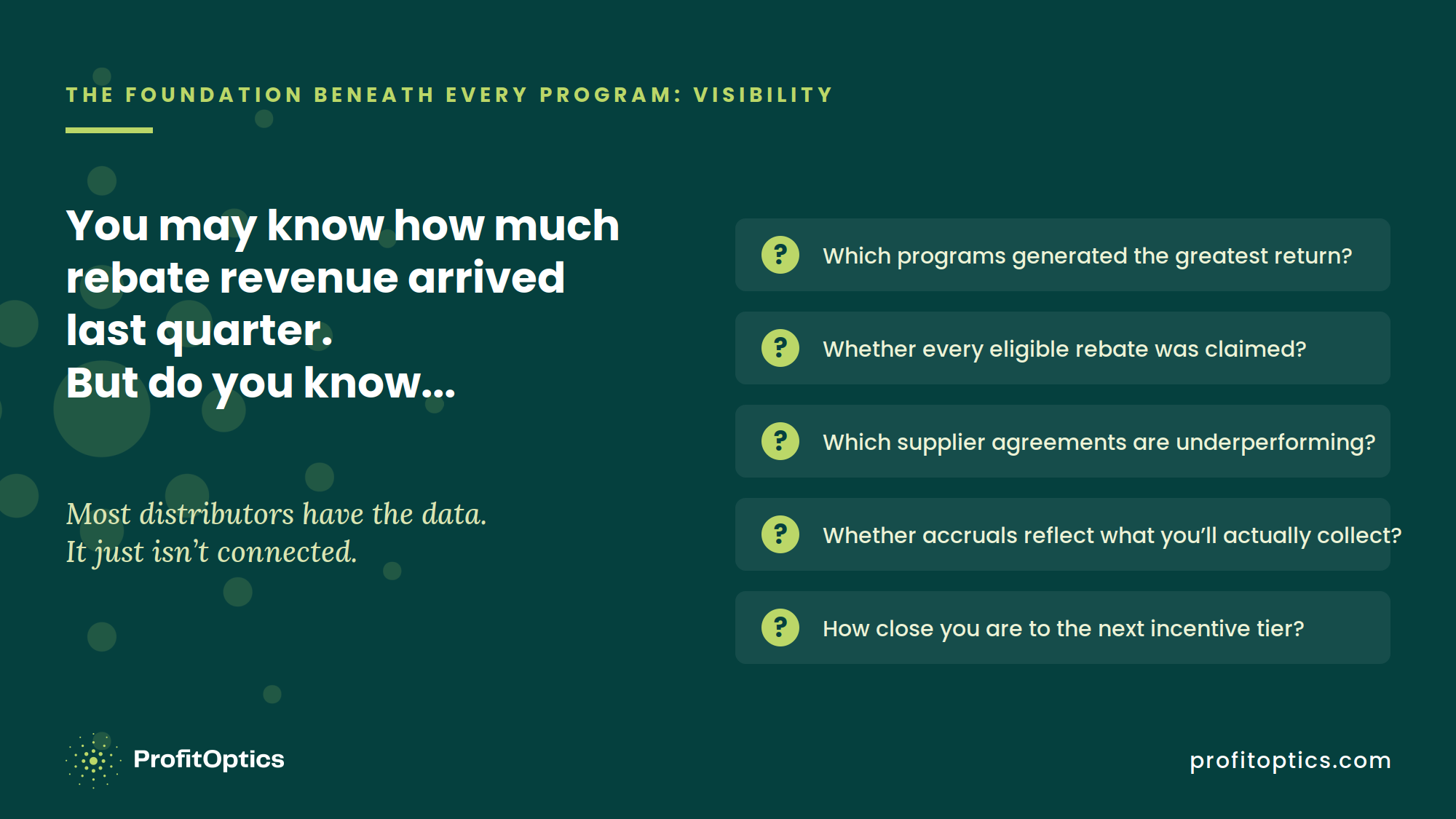
As rebate programs become more sophisticated, those disconnected sources create blind spots. You may know how much rebate revenue was received last quarter but not understand:
Data quality also plays a major role. Incomplete sales information, inconsistent hierarchies, outdated supplier agreements, and conflicting terms can affect calculations and reporting. But even accurate data creates limited value if it remains fragmented.
Fortunately, visibility problems are often easier to solve than they first appear. Most distributors have the data; they just need a better way to connect agreements, transactions, and performance into a complete picture.
As complexity grows, visibility becomes harder to maintain, and small gaps make it harder to see opportunities, forecast accurately, and maximize the value of supplier programs.
We've found that those gaps tend to appear in the same places, regardless of industry.
Because opportunity gaps are consistent across distributors, they can also be addressed systematically. Identifying where the gaps exist is often the first step toward capturing margin.
It’s hard to maintain a complete, centralized view of supplier contracts, incentive structures, eligibility requirements, and program changes. Some agreements are managed formally. Others are tracked through emails, spreadsheets, supplier portals, or individual relationships.
Without agreement visibility:
Teams often spend time:
The more time spent finding information, the less you have to act on it.
The payoff: With a single, trusted view of rebate agreements, teams spend less time searching for information, make more consistent business decisions, and reduce the risk of missed rebate opportunities.
Many supplier programs reward you for selling the right products, meeting growth targets, or reaching volume commitments. Reaching the next tier or incentive threshold can have a significant impact on margin, but many distributors miss those opportunities when program performance isn't visible in real time.
Too often, distributors discover what they could have earned only after the measurement period has closed.
When incentive tracking is limited:
The operational impact often includes:
The payoff: Real-time tracking allows distributors to identify issues early, make adjustments while programs are still in progress, and maximize rebate performance before opportunities are lost.
Accruals are intended to provide you with a reliable picture of expected rebate earnings. As supplier agreements become more complex, however, estimating collections is difficult. Volume thresholds, conditional incentives, product exclusions, and changing agreement terms can all affect rebate outcomes.
Inaccurate accruals can lead to:
Teams spend more time:
The payoff: Better accrual accuracy provides a more reliable view of expected rebate income, supporting stronger forecasting, financial reporting, and management decisions.
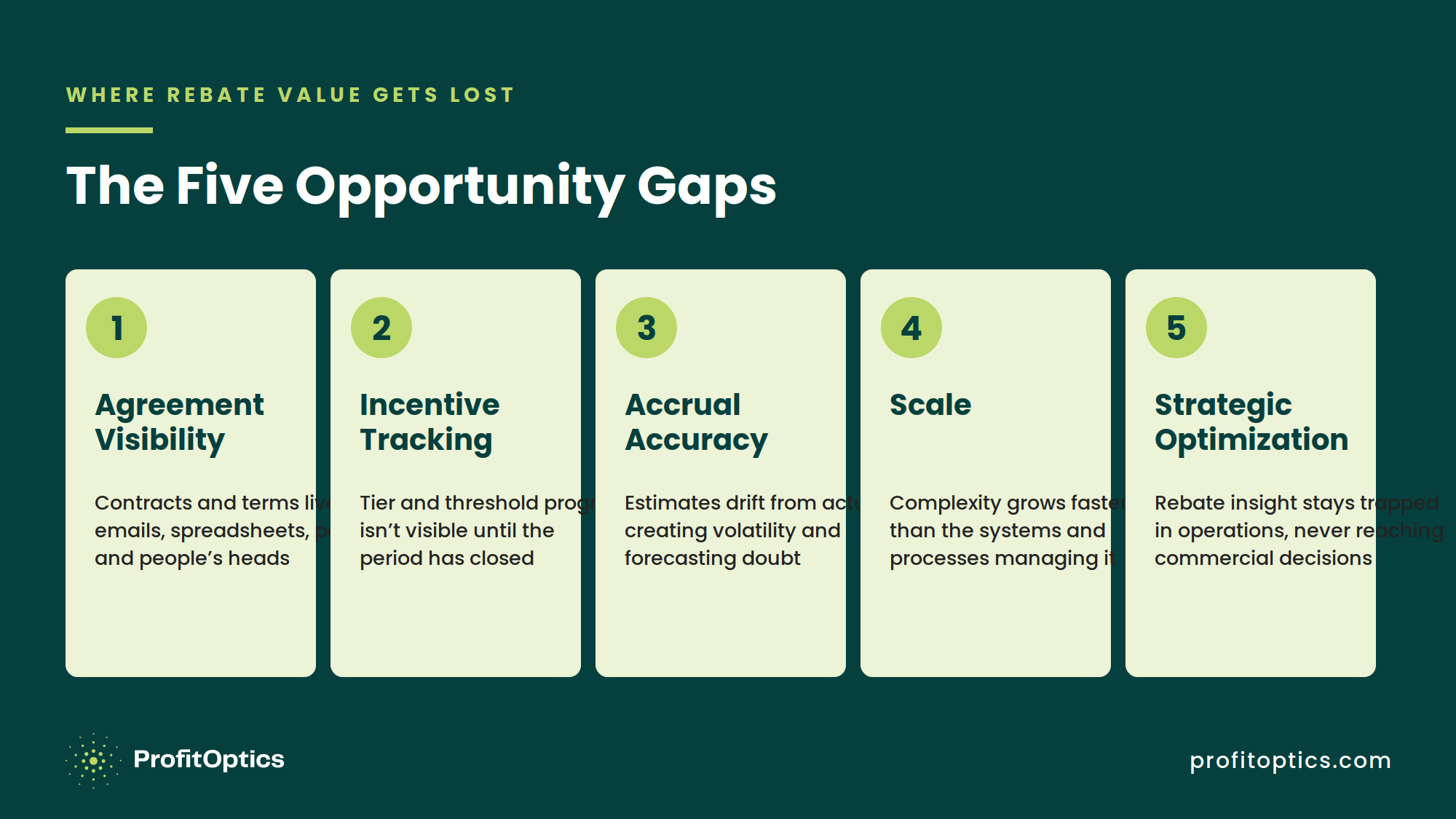
Most rebate processes work well enough when the business is smaller and programs are relatively straightforward. But as suppliers, agreements, products, and incentive structures increase, complexity grows faster than visibility. The result is missed revenue, delayed claims, uncollected dollars, and decisions based on incomplete information.
As scale increases:
The strain typically appears as:
The payoff: Automation and standardized workflows enable distributors to expand rebate programs and manage complexity without adding equivalent administrative overhead.
Rebate and incentive data can provide valuable insight into supplier relationships, purchasing decisions, customer programs, profitability, and growth opportunities. Unfortunately, many distributors never connect rebate performance to commercial decisions because data is trapped within operational processes.
When rebate insights remain isolated:
The payoff: When you have a system that allows you to share rebate insights beyond finance, distributors can make more informed pricing decisions, uncover new margin opportunities, and strengthen supplier relationships.
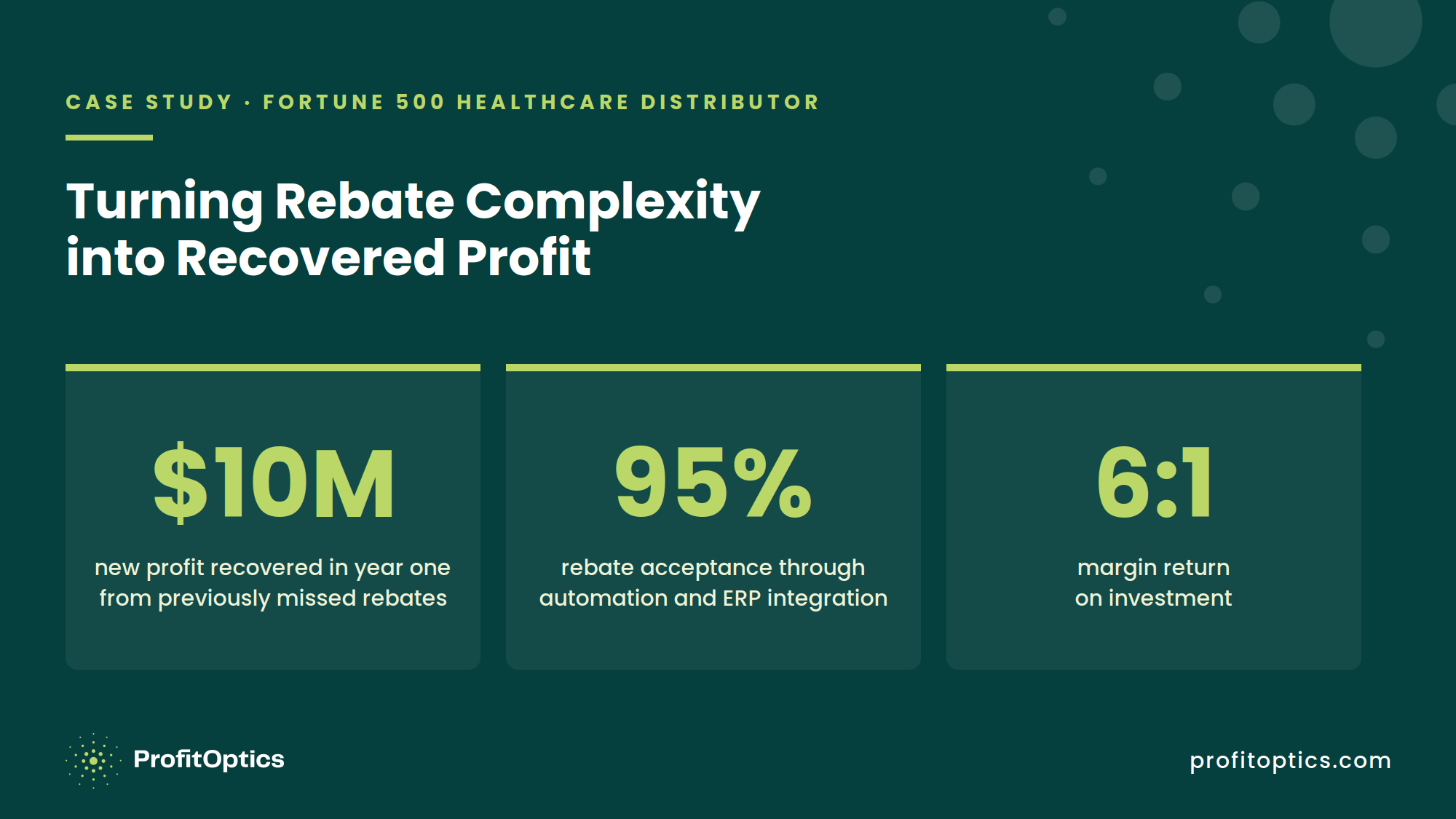
While every distributor's rebate environment is different, we've found that improving visibility and automation can produce measurable financial results across the board.
A Fortune 500 healthcare distributor was managing hundreds of vendors, tens of thousands of contracts, and millions of dollars in rebate opportunities. As program complexity increased, teams had a hard time identifying and capturing all eligible rebate revenue.
ProfitOptics implemented a rebate optimization solution that automated transaction validation, centralized rebate logic, and improved visibility across programs.
Results included:
The purpose of this model isn't to grade your company. It's to provide a practical framework for identifying the next improvements that will have the greatest impact.
Most distributors don't operate entirely within a single stage. Different suppliers, business units, or rebate categories often sit at different levels of maturity. When you look at this model in the context of your own business, your goal should be understanding where visibility is strong, where opportunities are being missed, and what capabilities could have the greatest impact as complexity increases.

You might be here if:
What matters at this level:
Most distributors start here. Building a repeatable process is often enough to create meaningful early improvements.
You might be here if:
What matters at this level:
This is usually where distributors begin seeing significant returns from standardization and automation.
You might be here if:
What matters at this level:
Once consistent processes are established, you can shift attention from managing rebates to improving performance.
You might be here if:
What matters at this level:
At this stage, rebate management begins contributing insights that influence broader business decisions, pricing strategy, and market competitiveness.
You might be here if:
What matters at this level:
This model helps you assess where you are today and improve how effectively you manage rebates.
Diagnostic
Map different rebate types (SPAs, volume rebates, co-op, customer incentives) to stages to identify where processes are manual vs. controlled.
Alignment
Create a shared understanding across finance, purchasing, and sales of how rebates are managed.
Prioritization
Focus on areas where low maturity intersects with high financial impact or high volume.
Once distributors see where they’re at, we’ve found that the conversation tends to move to:
“Where are we leaving money on the table, and where does it matter most?”
Rebates are too important to be treated as an administrative process.
Your next steps:
Few distributors have perfect rebate visibility, especially as supplier programs become more sophisticated. The important thing isn't eliminating every gap overnight. It's understanding where the biggest opportunities exist and making steady improvements over time. Even relatively small changes in visibility, process consistency, or incentive tracking can translate into margin gains.
Reach out today for a rebate audit.
A few quick answers for anyone assessing their own rebate program.
We've seen execution gaps erode 3% to 5% of margin. The losses rarely show up as one big miss. They accumulate as unclaimed rebates, delayed claims, calculation errors, and underperforming supplier programs that nobody is watching closely.
The data lives everywhere. Agreements sit in contracts and email threads. Transactions sit in the ERP. Claims and accruals sit in spreadsheets and supplier portals. Each piece may be accurate on its own, but nothing connects them into one picture of what you've earned versus what you've collected.
Agreement visibility, incentive tracking, accrual accuracy, scale, and strategic optimization. They show up in the same places regardless of industry, which means they can be addressed systematically. Finding where they exist in your business is the first step toward capturing margin.
A five-level framework running from Reactive to Strategic. It isn't a report card. It's a practical way to identify which improvements will have the greatest impact next. Most distributors sit at different levels across different suppliers and rebate types, and that's normal.
Usually not. Most distributors already have the data they need. The biggest gains typically come from improving visibility, automating manual processes, and connecting information that already exists across the business. The goal is capturing more of what you've earned, not a rip and replace.
Map where rebate capture is strong, where it falls apart, and where the financial impact is greatest. Then focus there. A rebate audit is the fastest way to get that picture. Reach out to our team to start one.
ProfitOptics consults and builds solutions to protect and grow margin for distributors and manufacturers in pricing, rebates, and quoting, with tools designed to work alongside the systems you already run.