July 22, 2026




Here’s what I cover in this article:
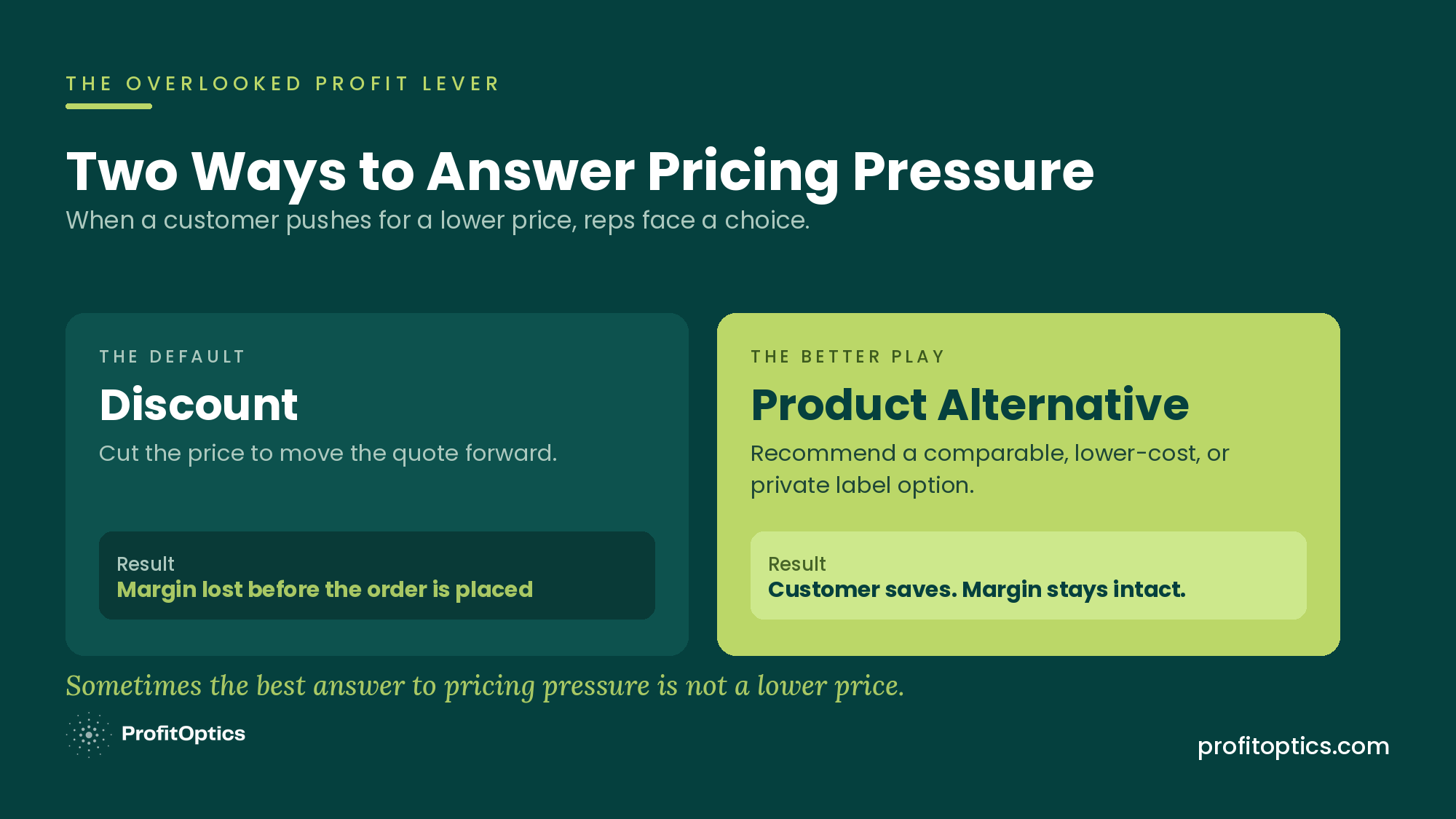
When customers push for lower prices, many distributor reps immediately go to price cuts. They assume that if a customer wants savings, the distributor has to give something up to keep the business.
But sometimes, there is another option.
Instead of lowering price, distributors can recommend a product alternative – a comparable substitute, a lower-cost equivalent, or a private label option that solves the customer’s problem without hitting the bottom line.
The challenge is that many sales reps simply do have not enough visibility into these opportunities during the quoting process.
So, they default to discounting, substitute opportunities are missed, and the company loses margin before an order is ever placed.
Today’s market is making product alternatives more important.
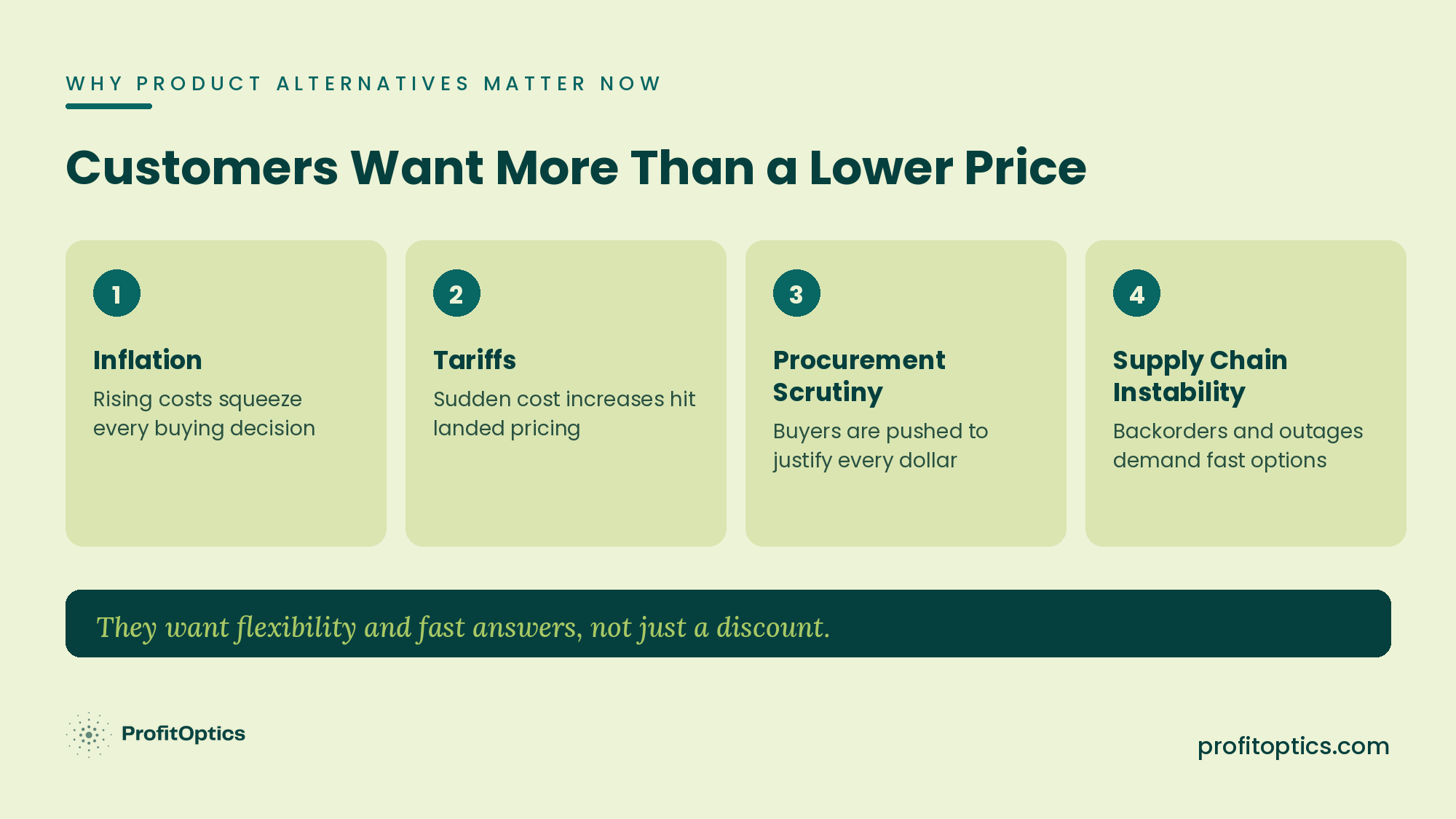
Customers are under pressure. Inflation, tariffs, procurement scrutiny, and supply chain instability continue to create challenges for customers. They want not only lower prices but more flexibility – continuity when products are unavailable and faster answers when supply disruptions occur. If a requested product is unavailable, too expensive, or backordered, reps need to quickly identify viable alternatives.
Product alternatives create flexibility without automatically cutting margin. Internally, many teams see this as a “switch-to-save” opportunity. Instead of discounting a product, the distributor helps the customer move to another option that meets the operational need while creating savings. It’s a win-win. Deliver savings to the customer and secure healthier margins for the distributor.
Visibility into alternatives helps reps respond faster. This becomes especially important during out-of-stock situations, supplier disruptions, tariff-driven cost increases, and competitive quote situations.
Without immediate access, reps have to manually search across spreadsheets, ERP systems, and emails, and tap into the knowledge often living inside the team’s heads. Quotes slow down, customers wait longer for answers, and discounting becomes the fallback. Reps know that slow quotes often mean lost business, and they don’t want to risk that. That is why many distributors end up unnecessarily sacrificing margin even when substitutes already exist.
Despite its clear benefits, distributors still struggle to provide the kind of clarity reps need around product alternatives. Here’s why:
Product knowledge is fragmented. Substitute relationships may exist in spreadsheets. Product attributes may sit inside ERP systems. Pricing data may live somewhere else. In many distribution companies, product knowledge still depends heavily on tribal knowledge from merchandising teams or long-tenured employees.
The result is incomplete mapping and inconsistent visibility into alternatives.
In many cases, reps simply do not have an easy way to identify whether one product is truly comparable to another. They do not have an alternate data set that clearly tells them this item is an exact match, a similar match, or a viable replacement option.
Product matching is more complicated than most realize. Reps may need to reconcile:
For example, one supplier may package eight reams per case while another packages 10. If those unit-of-measure differences are not normalized, quote comparisons are inaccurate.
In many competitive quote situations, distributors win or lose business based on how effectively they can cross-reference products and offer appropriate alternatives.
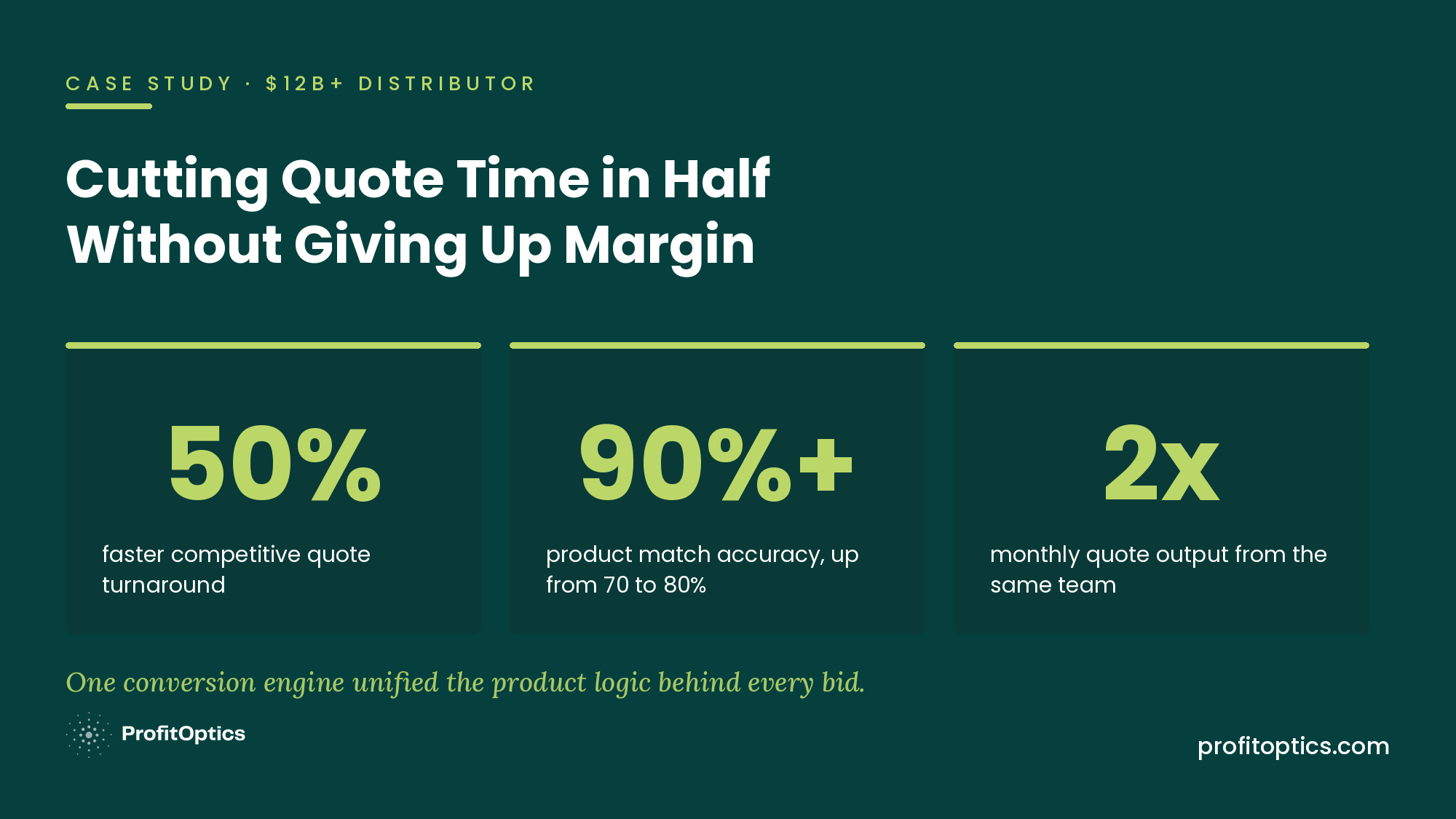
For one distributor, competitive quotes took three to four weeks to complete, with matching accuracy stuck at 70–80%. Their internal systems and data were fragmented, forcing teams to manually parse, normalize, and correct thousands of SKUs for every competitive bid. These delays created customer frustration, backlog and a major disadvantage in high-value opportunities. Partnering with ProfitOptics, they built a conversion automation engine that unified product logic and lifted accuracy above 90%. Turnaround times were cut by 50% and monthly output doubled, restoring speed, rep confidence, and competitive advantage.
Being able to see reliable alternatives in the quoting process depends on connected, reliable product data. But in many companies, product data, customer agreements, costs, and contract terms are still managed across multiple disconnected systems.
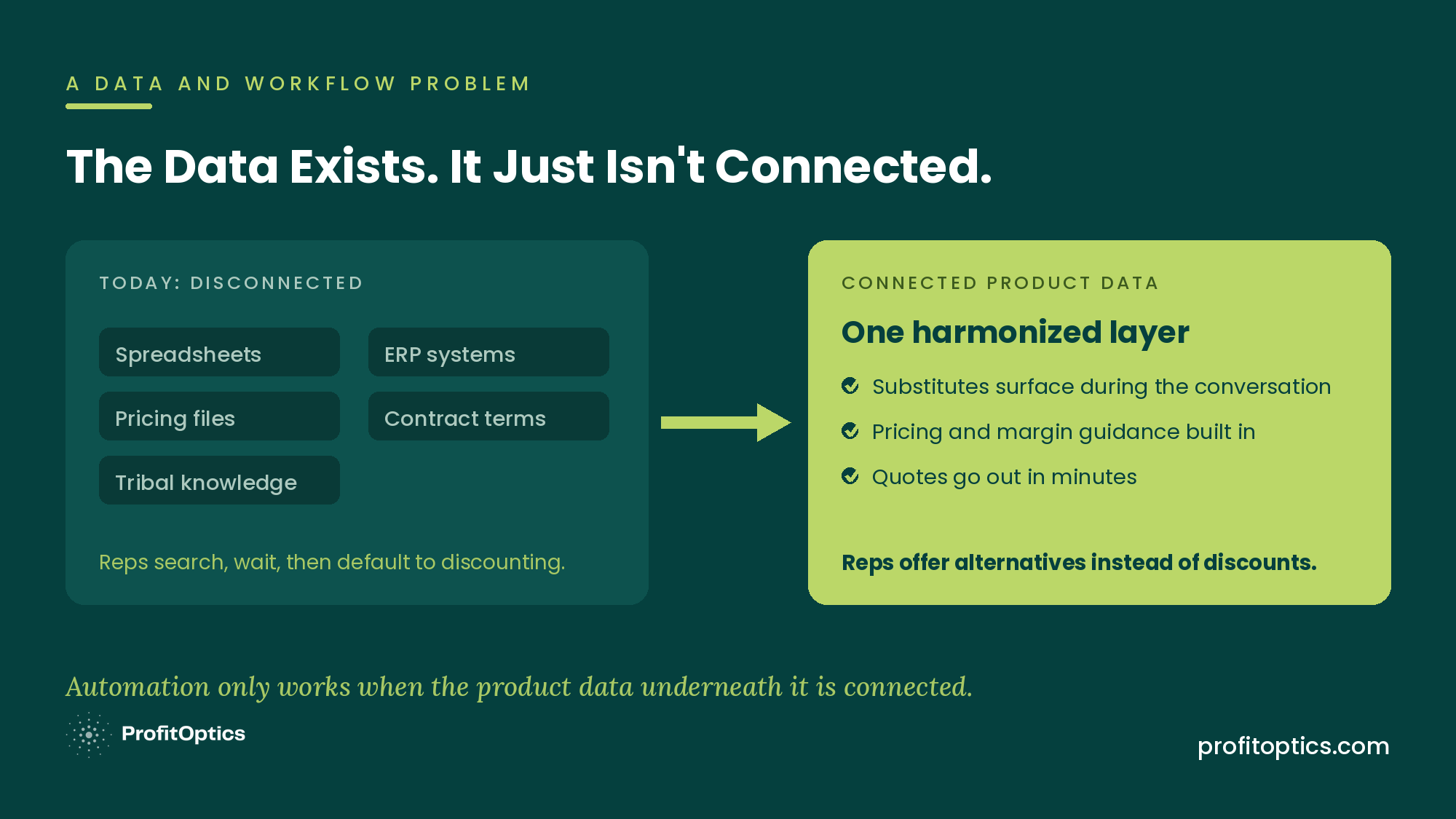
Reps waste time searching for information, and merchandising teams get pulled into manual product matching exercises. Quotes take longer to complete.
Many distributors are now exploring AI-assisted quoting, intelligent product matching, and automated substitution recommendations. Those capabilities can improve speed and consistency. But none of them work effectively without centralized product data. If substitute relationships are incomplete, pricing logic is fragmented, or product attributes are inconsistent, automation won’t help.
The solution is to invest in quoting tools and harmonized product data that make substitutes easier to identify during customer conversations. When reps can quickly understand substitute options, customer fit, pricing guidance, and margin impact, they are less likely to default to discounts.
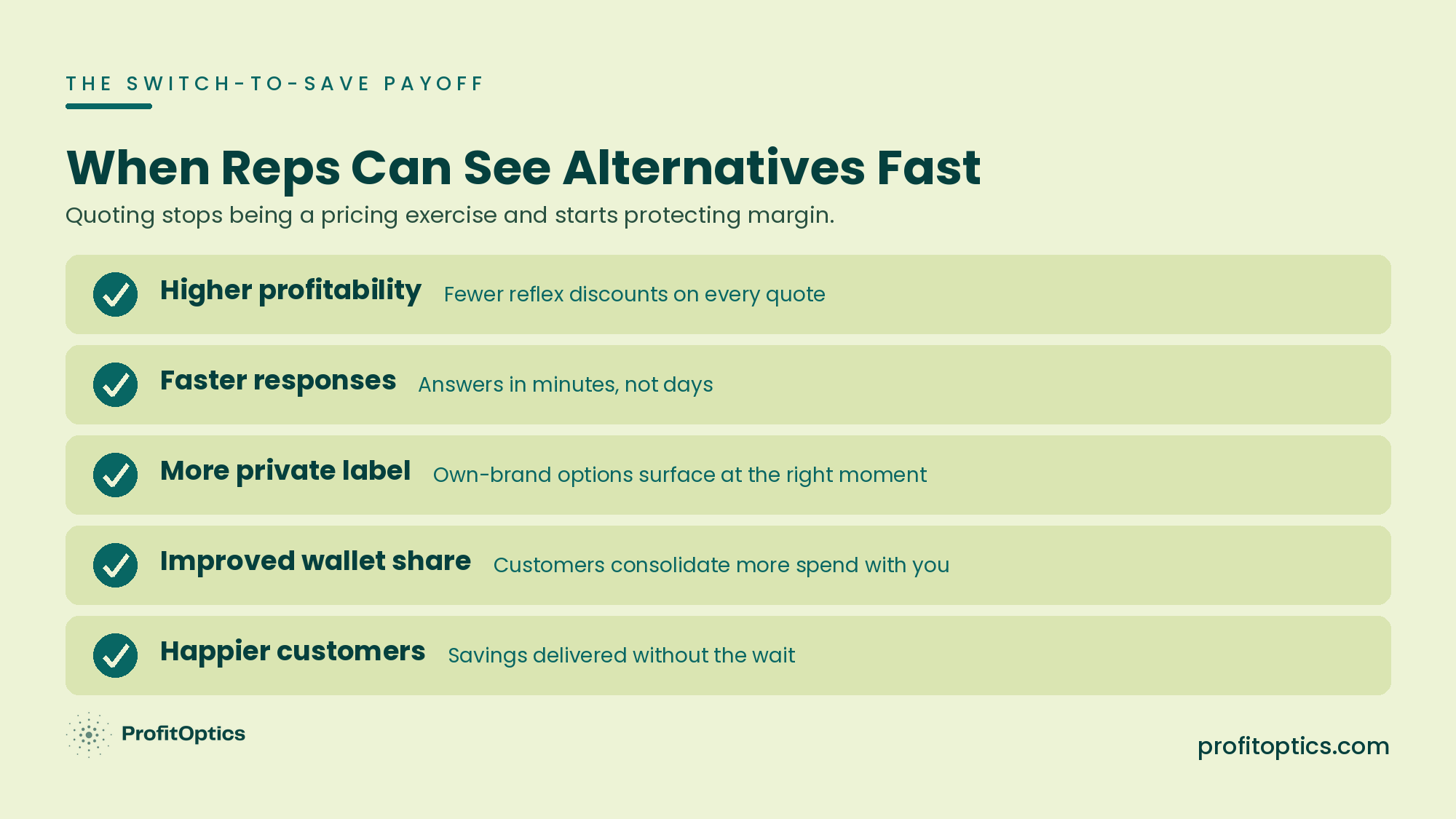
This changes the role of quoting entirely. Instead of becoming a reactive pricing exercise, quoting becomes an opportunity to protect margin, improve responsiveness, and strengthen customer relationships.
Because in many cases, the best answer to pricing pressure is not lowering price. It is helping the customer see a better alternative.
If your reps are cutting price because they can't see alternatives fast enough, that's not a sales problem. It's a data and workflow problem. And it's fixable.
We've helped distributors connect product data to quoting so reps can offer substitutes instead of discounts. If you want to talk through what that would look like in your business, let's have a conversation. No pitch. Just a working session on where your margin is leaking and what it would take to stop it. Get in touch.