October 19, 2026



Time to Price (TTP) measures the number of days between a price change’s intended effective date and its actual effective date. For distributors, TTP helps reveal whether pricing decisions are being implemented on schedule—and where delays may be costing margin.
A distributor can choose the right price and still miss the intended financial benefit if that price takes effect late. Measuring TTP gives executive leaders and pricing teams a shared way to evaluate execution, identify bottlenecks, and prioritize improvements.
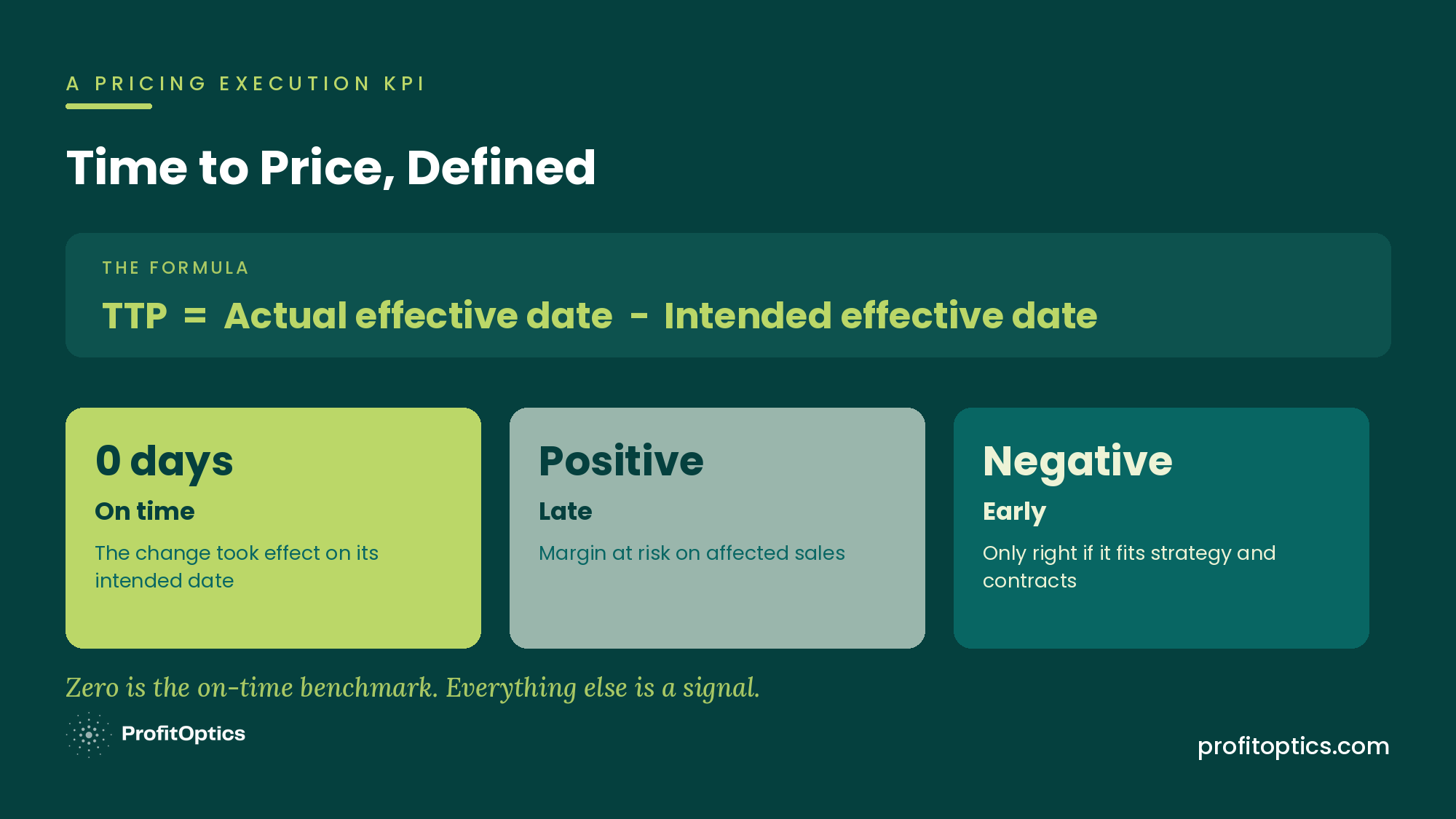
Time to Price is a pricing execution metric calculated as:
TTP = Actual effective date − Intended effective date
The intended effective date is when the distributor plans for a new price to take effect. The actual effective date is when that price becomes active for the applicable business.
|
Intended effective date |
Actual effective date |
TTP |
Meaning |
|
October 1 |
October 1 |
0 days |
Implemented on time |
|
October 1 |
October 5 |
+4 days |
Implemented four days late |
|
October 1 |
September 27 |
−4 days |
Implemented four days early |
A TTP of zero is the on-time benchmark. A positive TTP indicates a delay. A negative TTP indicates early implementation.
Early implementation may create additional margin opportunity, but it is not automatically the right outcome. The timing must still align with customer commitments and the business’s pricing strategy.
Pricing decisions create value only when they take effect. If supplier costs increase before a distributor updates its customer prices, the delay can reduce margin on affected sales.
Based on ProfitOptics’ work with hundreds of distributors, each additional day of delay can represent approximately 0.25 to 0.5 basis points of margin on affected sales. A 10-day delay can therefore represent approximately 2.5 to 5 basis points.
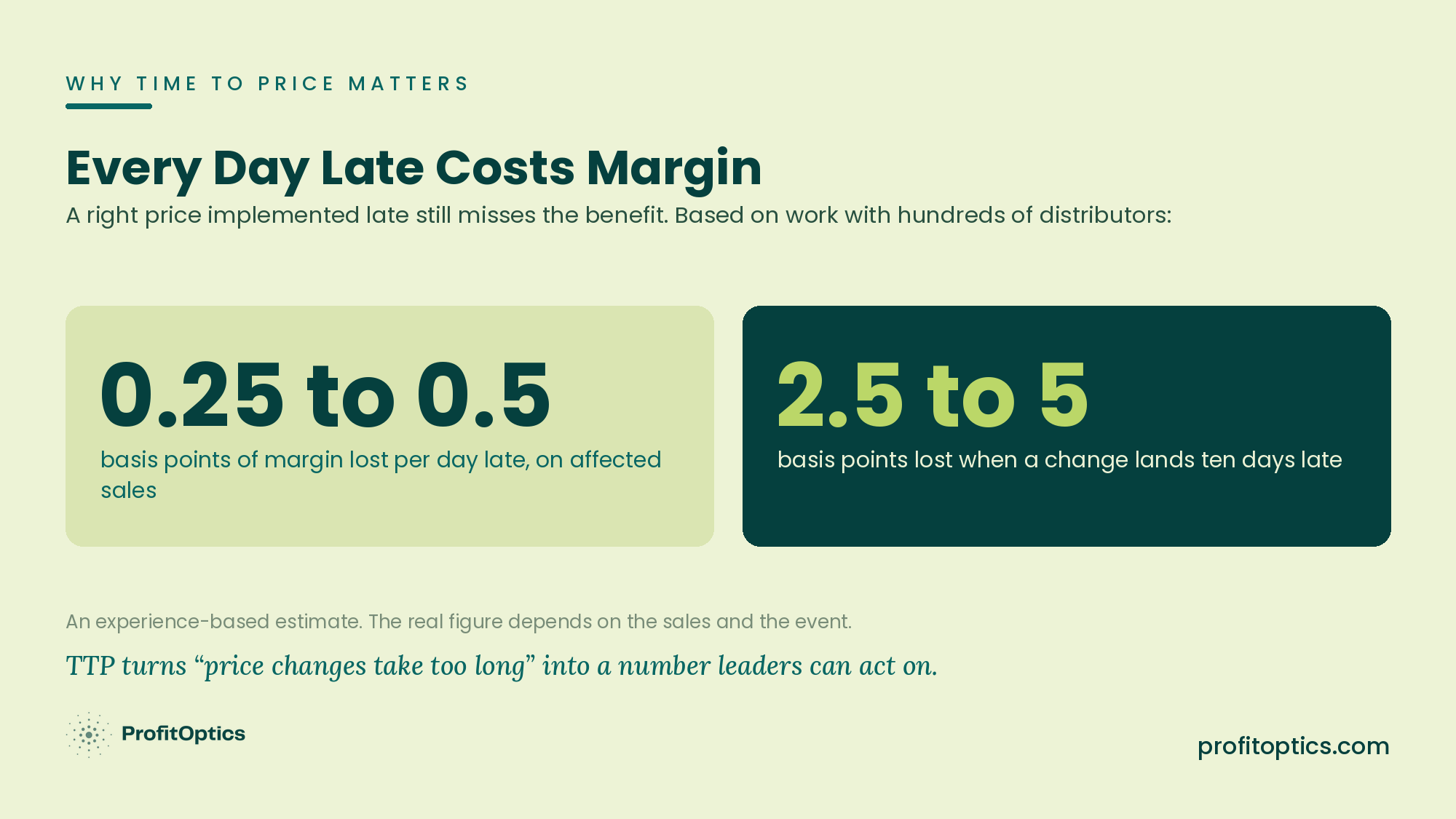
This is an experience-based estimate, rather than a fixed result for every distributor or price change. The actual impact depends on the affected sales, the intended adjustment, and the circumstances of the event.
Measuring TTP helps leaders move from a general concern—“price changes take too long”—to a specific business discussion:
A measurable pricing event needs a defined scope and an intended effective date.
Common examples include:
For supplier cost increases, the supplier’s effective date can be a natural reference point for the distributor’s intended pricing date. However, the distributor should explicitly establish when its own changes should take effect.
TTP can also measure planned price decreases. The metric evaluates execution against an intended date; it does not judge whether the pricing decision itself was correct.
Distributors should measure TTP against addressable business: the sales eligible for the specific price change.
Not every customer, product, or transaction will qualify. For example, a contract may prevent a distributor from changing a customer’s price during a specified period.
Other exceptions may reflect deliberate business decisions, such as:
These exceptions should be explicit and documented. Excluding an entire customer or product category because some prices are complicated can hide execution problems.
Start with the business clearly eligible for the change. Refine the treatment of exceptions as the measurement process develops.
A long TTP is not necessarily a pricing-team problem. Pricing teams often depend on sales, purchasing, IT, and other functions to complete a change.
Common sources of delay include:
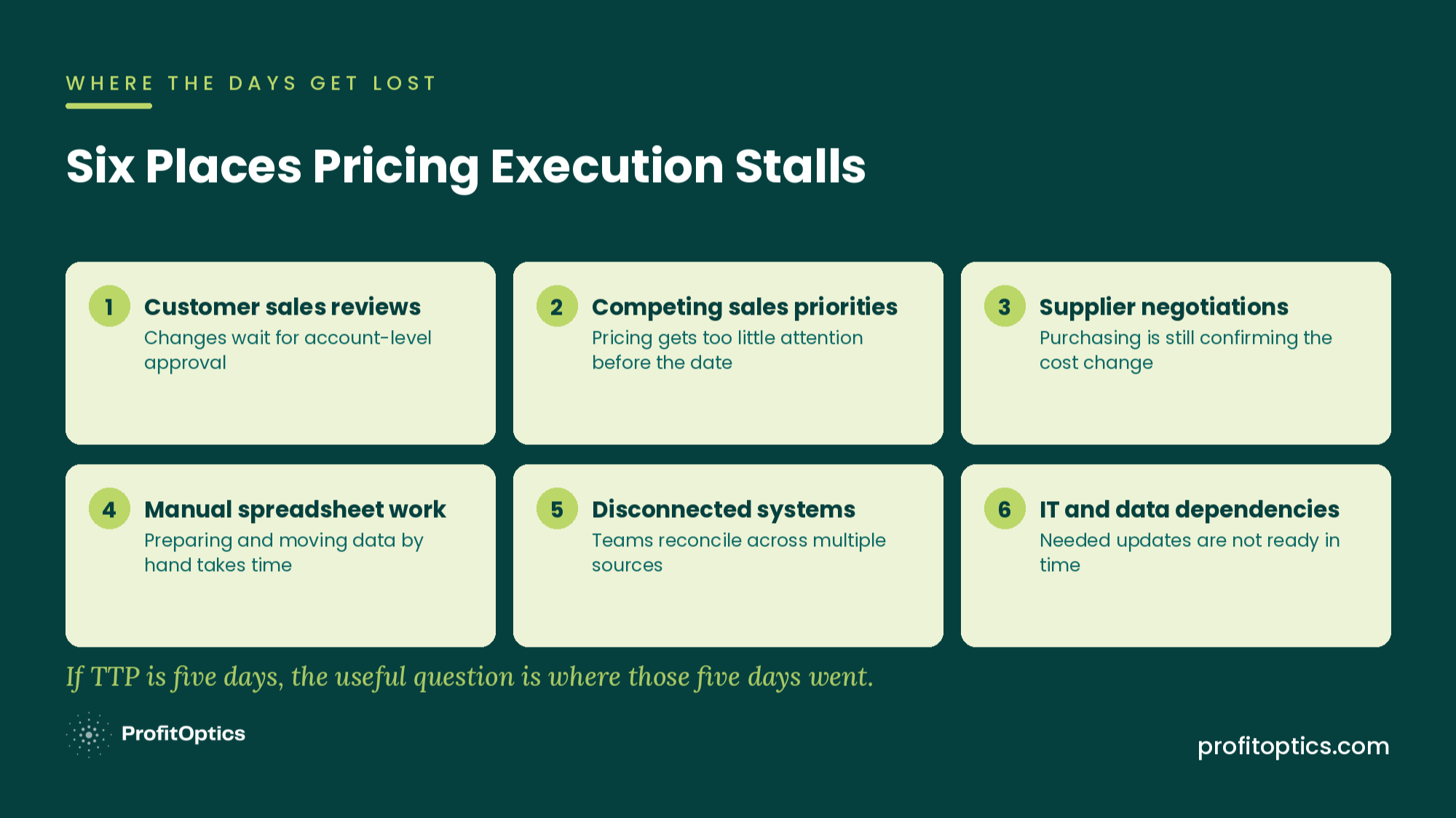
If TTP is five days, the useful question is: Where did the organization lose those five days?
Pricing may own the measurement, but improving the result can require action across several departments.
Start with one clearly defined pricing event and record:
If a change takes effect in stages, record the actual dates for the relevant portions of the business. A single completion date can conceal differences between changes implemented on time and those implemented late.
Use consistent definitions across events so leaders can compare results and identify recurring problems.
TTP connects an operational delay to a measurable business issue.
Instead of saying that the team needs faster tools or more support, pricing leaders can explain:
“We intended this pricing change to take effect on January 1. Implementation finished five days late. These sales were affected, and this is the estimated margin opportunity associated with the delay.”
That evidence helps leaders determine where to act.
If sales reviews repeatedly cause delays, the business can clarify deadlines and accountability. If spreadsheet work slows implementation, leaders can assess process improvements or automation. If disconnected data creates bottlenecks, the team can connect a technology investment to a specific execution problem.
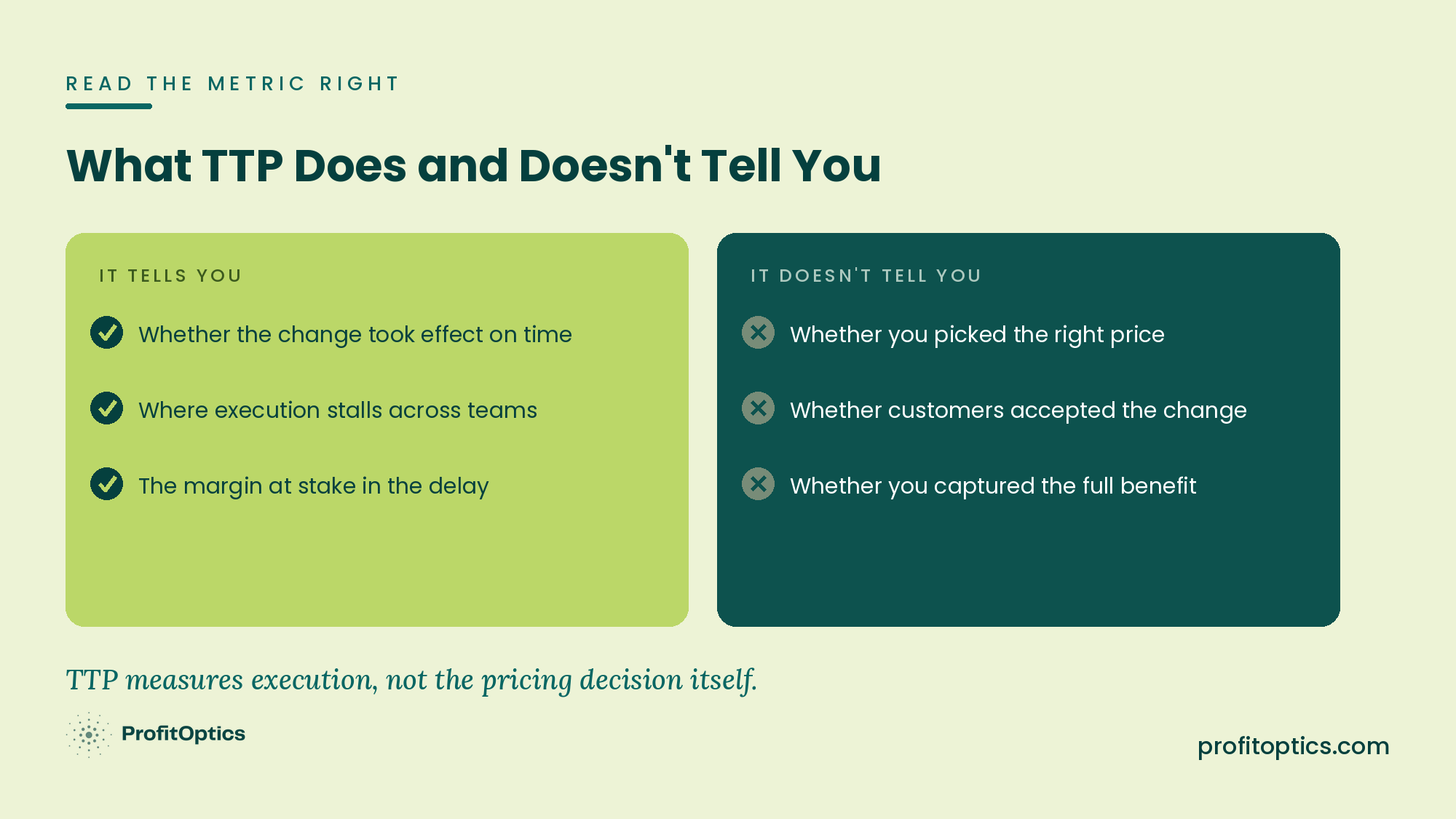
TTP measures whether a pricing change took effect when intended.
It does not establish whether the distributor selected the right price, whether customers accepted the change, or whether the business captured the full intended financial benefit.
Those questions require other pricing measures. TTP adds visibility into a distinct part of performance: the organization’s ability to carry a pricing decision through to implementation.
Distributors invest significant effort in determining what prices should be. Measuring Time to Price helps ensure those decisions reach the market on schedule.
With a defined scope, consistent dates, and documented exceptions, TTP gives leaders a practical way to identify delays and improve pricing execution.
Ready to measure your pricing execution? Talk to ProfitOptics about tracking TTP across your business and identifying opportunities to improve it.
Time to Price (TTP) is the number of days between a distributor’s intended price-change effective date and the date the new price actually takes effect. It measures pricing execution against a planned schedule.
Subtract the intended effective date from the actual effective date:
TTP = Actual effective date − Intended effective date
If prices were intended to take effect on October 1 but became active on October 5, TTP is positive four days.
A TTP of zero is the on-time benchmark: the price change took effect on its intended date. Distributors should evaluate results using a clearly defined scope and documented exceptions.
Yes. TTP is negative when a price change takes effect before its intended date. Early implementation may create margin opportunity, but it should align with customer commitments and the distributor’s pricing strategy.
When supplier costs rise before customer prices change, a distributor may earn less margin on affected sales during the delay. The impact depends on sales volume, the intended price adjustment, and the specific pricing event.
Pricing teams may track TTP, but improvement often requires coordination across sales, purchasing, IT, and leadership. Responsibility for resolving a delay should follow the process step that caused it.
Business that is contractually ineligible for a price change should be excluded from that event’s addressable scope. Distributors should document exclusions so the metric accurately reflects eligible business.
TTP measures implementation timing. It should be considered alongside other measures to evaluate price selection, customer response, and the financial results of a pricing strategy.
ProfitOptics helps distributors measure Time to Price, identify where price changes get delayed, and evaluate opportunities to improve execution. By connecting those delays to affected sales and potential margin impact, ProfitOptics helps pricing leaders build a business case for process changes, better data, or technology investment.
Talk to ProfitOptics about assessing your pricing execution and identifying opportunities to reduce delays.