November 2, 2026




The quick take:
Run the assessment with your team. The Distributor Pricing Maturity Model includes stage-by-stage checklists and discussion questions.
Ask five people on a distribution leadership team how mature their pricing is and you'll often get five different answers. Sales thinks it's too rigid. Finance thinks it's too loose. The pricing team knows exactly which spreadsheets are holding things together.
All of them can be right at the same time. Pricing touches sales, finance, merchandising, supply chain, customer service, and leadership, and each group sees a different slice of it. That's why a structured assessment matters. It gives everyone the same frame for talking about what's working, what isn't, and what to fix first.
We introduced the framework in The Distributor Pricing Maturity Model. This guide is the practical companion: how to actually run the assessment with your team, what to look for, and how to turn the results into a plan. The full report is available as a free download.
Before the team scores anything, agree on what you're measuring. It's tempting to treat pricing maturity as a technology question: do we have a pricing engine or not? That misses the point. Software only helps when the business around it is ready to use it.
A better test is performance. A mature pricing operation:
The two outcomes to keep in view are balanced, profitable sales growth and the protection and growth of margin. As pricing matures, it stops acting like a standalone department and starts acting as the function that coordinates decisions across the business.
Don't try to rate pricing as a whole. Break it into five components and look at each one on its own. They depend on each other, so a weak spot in one usually holds back the rest.
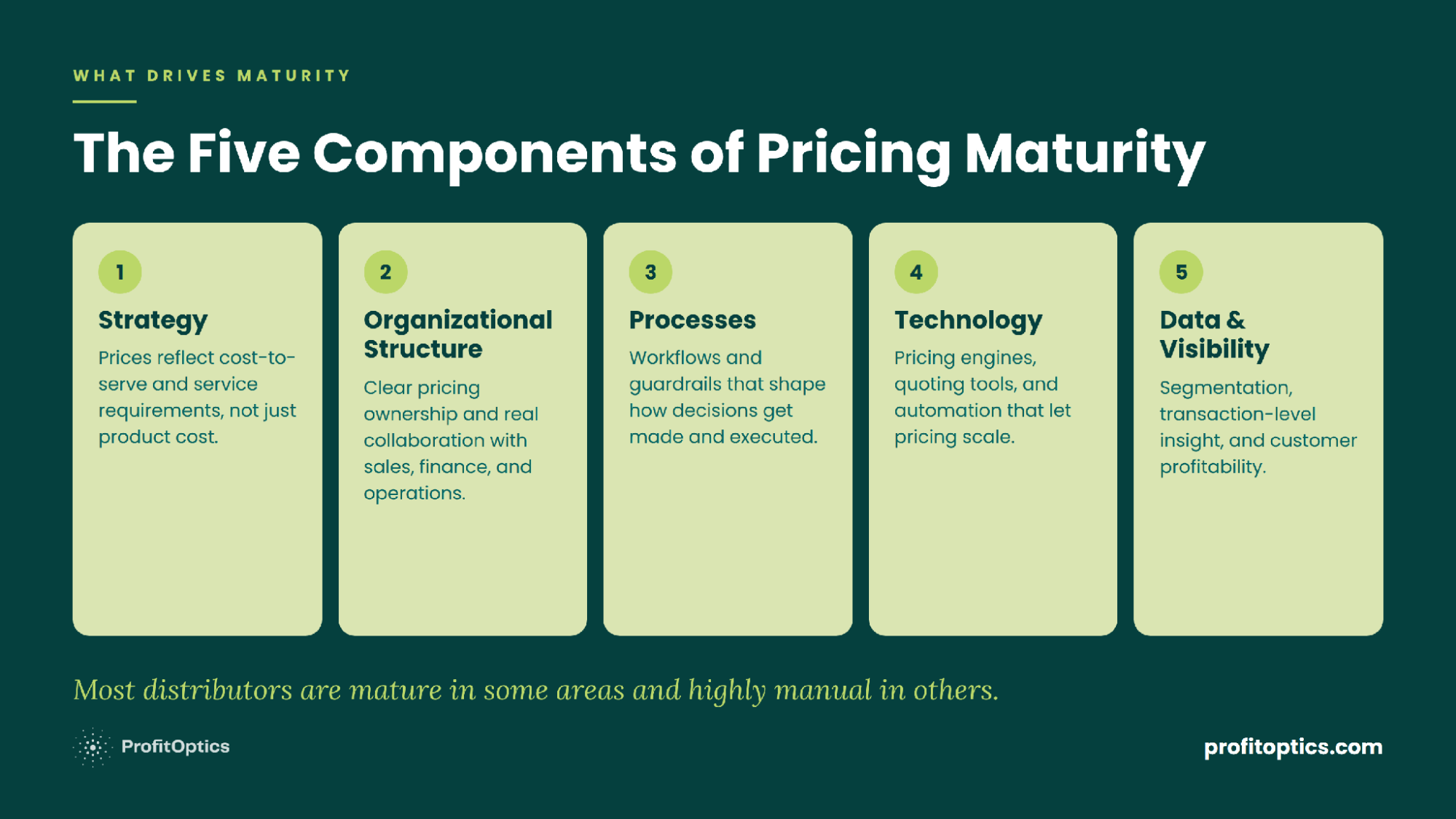
Once you've looked at each component, place it on the curve. Resist the urge to land on a single company-wide level. It's common for data and visibility to sit at one stage while organizational structure sits at another. Those mismatches are exactly what the exercise is meant to surface.
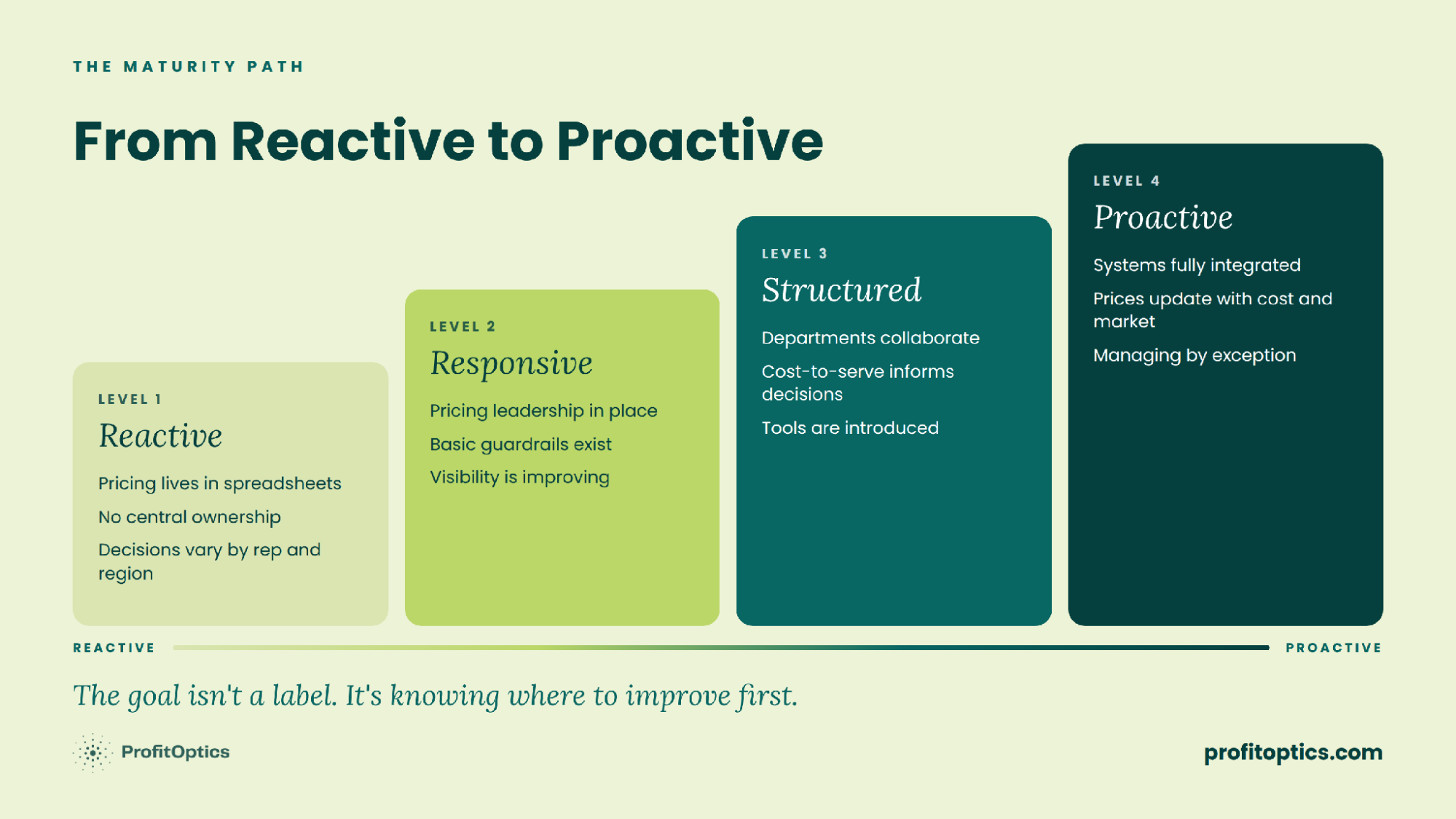
Signs: Spreadsheets and individual know-how drive pricing. No one clearly owns it. Decisions change depending on the rep, the region, or the day. Profitability is hard to see, and prices come from product cost plus habit.
Priority: Assign ownership, then put basic guardrails in place, like a floor that prevents selling below cost, approval thresholds, and a consistent way to pass through cost increases.
Signs: Someone leads pricing. Basic governance and some guardrails exist. The business reacts to cost and market changes more consistently, reporting is getting better, and customer profitability is starting to enter the conversation.
Priority: Segment customers and products, tie pricing to customer value and item importance, and start adding tools that support day-to-day decisions.
Signs: Teams collaborate across departments. Cost to serve and customer profitability shape decisions, and pricing supports broader sales, sourcing, and growth plans. Some tools are already in place.
Priority: Centralize pricing in an engine that combines cost signals, product data, contracts, and segmentation. Automate updates where it makes sense, and bring in AI to speed up data work, contract review, and consistency across long-tail items.
Signs: Systems are fully connected. Prices adjust as costs, inventory, and market conditions change, and they reflect the full economics of serving each customer, including delivery, service, rebates, and operating costs.
Priority: Protect trust in automated decisions, manage by exception rather than reviewing every transaction, keep systems integrated, and sustain performance as the business grows.
First answers tend to be optimistic. To get an honest read, ask how pricing works in the field, in quoting, and when things go wrong, not how it works on paper. These questions help:
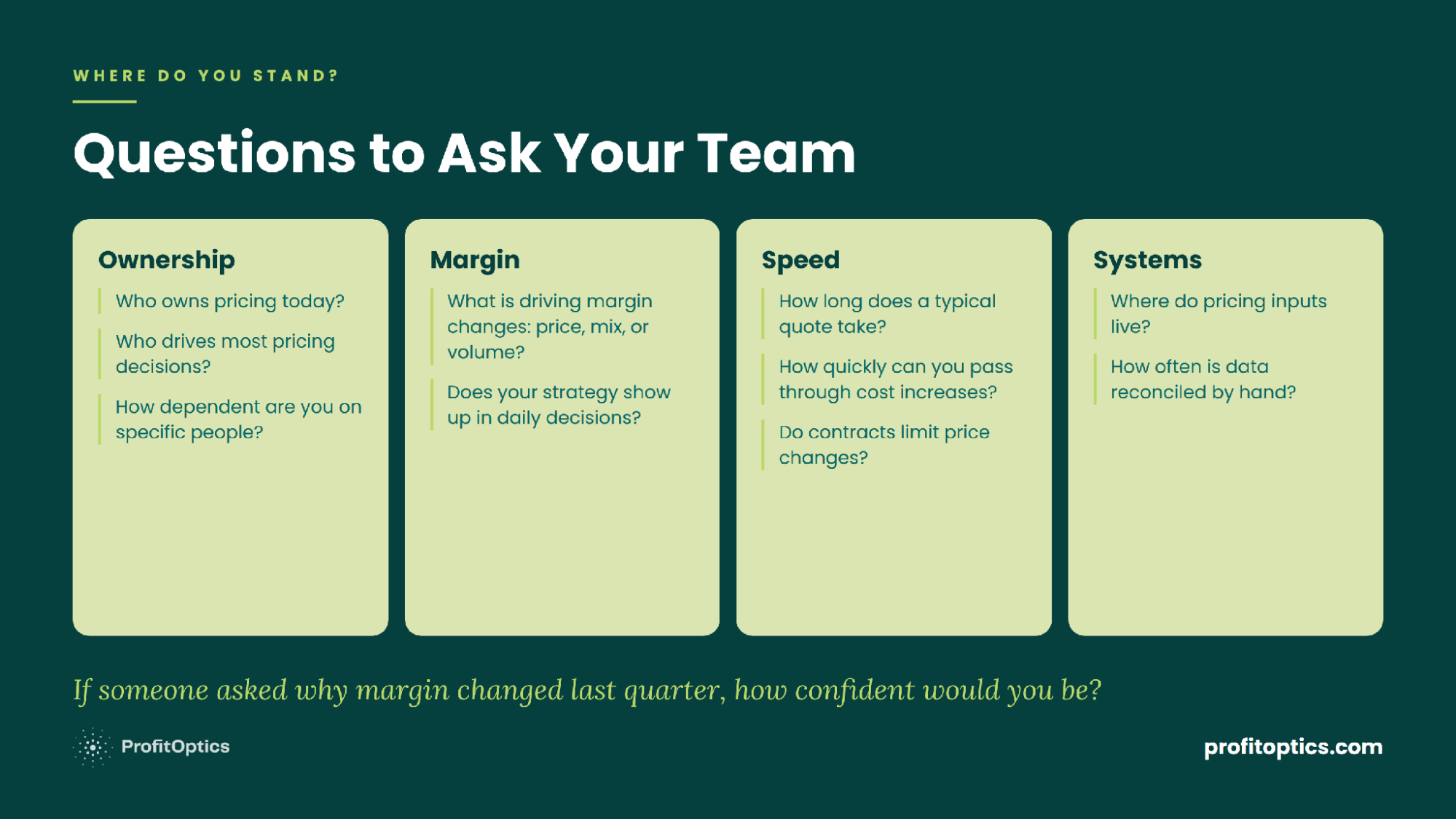
One question cuts through quickly: if your CEO asked tomorrow why margin moved last quarter, how confident would you be in the answer?
Most assessments end up raising the AI question. The honest answer is that AI won't fix weak fundamentals. It amplifies whatever process and data it's given. But once the foundation is in place, it's well suited to work that's too large, fast, or complex for people to handle well:
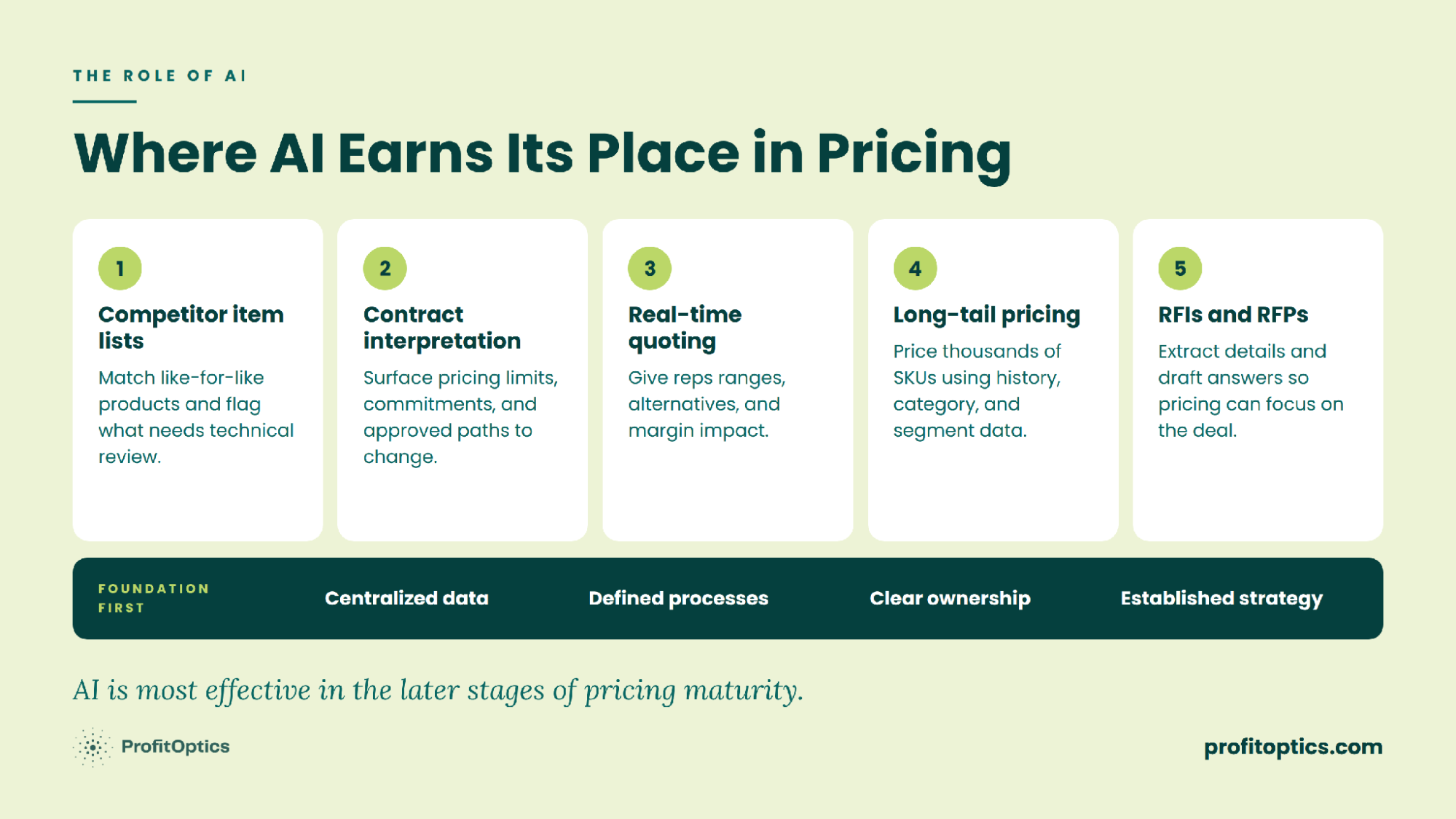
If your assessment shows gaps in centralized data, defined processes, clear ownership, or strategy, address those first. AI layered on top of them will produce recommendations without context, inconsistent outputs, and a team that stops trusting the system.
The point of the assessment is action. Pricing changes show up in revenue and profit faster than most initiatives, so a focused list beats a long roadmap. Pick the two or three gaps that are costing the most margin today, assign owners, and revisit the assessment in a few months to see what moved.
Want an outside view? ProfitOptics works with distributors to assess pricing maturity across strategy, structure, process, technology, and data, then build the pricing, rebate, and quoting capabilities to close the gaps. Reach out to schedule a pricing assessment.
Look at five components separately (strategy, organizational structure, processes, technology, and data and visibility), place each one on the maturity curve, and pressure-test the results with questions about how pricing works in practice. Then prioritize the few gaps with the biggest margin impact.
Include the people who touch pricing decisions: pricing, sales, finance, merchandising, supply chain, and leadership. Each group sees a different part of the picture, and the disagreements between them are often the most useful findings.
Reactive, Responsive, Structured, and Proactive Revenue and Margin Management. Most distributors land at different levels for different components, so the model is more useful as a discussion tool than as a single score.
Pricing that lives in spreadsheets and people's heads, no clear owner, decisions that vary by rep or region, little visibility into profitability, and prices set mainly from product cost and past practice.
No. AI works best in the later stages of maturity. Without centralized data, defined processes, clear ownership, and an established strategy, its recommendations lack context and people stop trusting them.
Revisit the assessment after you've acted on your top priorities, typically every few months, so you can confirm what improved and choose the next gaps to close.
ProfitOptics advises and builds software to protect and grow margin for distributors and manufacturers. We work where margin is decided: pricing, rebates, and quoting, all running on one clean data foundation.
Both. Most firms make you choose between strategy and software. ProfitOptics was built to do both: advisory pinpoints the highest-impact work, and delivery shapes the software to it, including your workflows, your systems, and your spec. The people who diagnose the problem are the people who build the solution.
Distribution and manufacturing are the only industries ProfitOptics serves, so the team is fluent in how these businesses operate from day one.
Yes. ProfitOptics builds pricing, rebate, and quoting software around a company's existing ERP, systems, and workflows rather than requiring the business to adapt to a generic platform.
Get the checklists and discussion questions in one place. Download The Distributor Pricing Maturity Model.