August 11, 2026




If you take anything away from this article, I want it to be this:
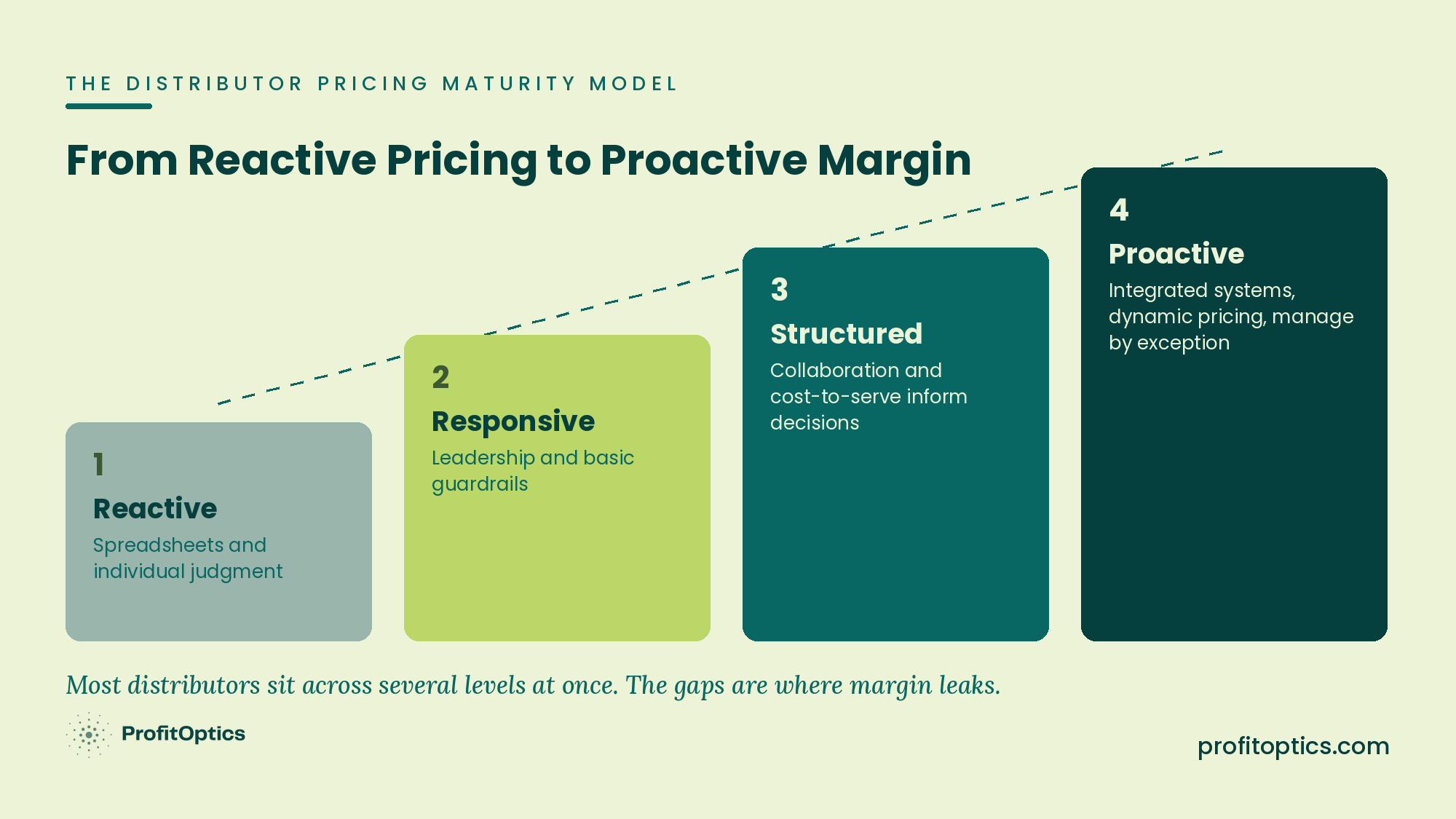
Most distributors do not think their pricing is broken. Quotes go out. Customers buy. Margins look acceptable from a distance.
Then something changes. A supplier announces a cost increase. A tariff lands. Demand shifts in one region and not another. That is usually when the cracks show, because pricing was never actually under control. It was stable, which is a different thing.
Pricing is not a number you set once and move on from. Every pricing decision is shaped by customer agreements, supplier costs, rebate programs, delivery models, sales strategy, market conditions, and operational realities. Pricing teams sit at the center of sales, finance, merchandising, supply chain, customer service, and leadership. When the process underneath all of that is immature, teams react to each situation as it arrives. Balancing profitability, growth, and customer expectations at the same time becomes very difficult.
I built this model to give leadership teams a more honest way to talk about where they actually stand, where pricing decisions get made, why they break down, and where improvement will have the greatest impact.
Reality check. Pricing maturity is more than having pricing technology. It shows up in four places:
Without structure, pricing becomes reactive. Reactive pricing almost always costs margin.
Maturity should produce two outcomes: balanced, profitable sales growth, and margin protection and growth. Everything else is in service of those two things.
Pricing is one of the few functions connected to nearly every part of a distribution business. As distributors mature, pricing stops being a standalone function and becomes a coordinating force that aligns decisions across the business.
Five components shape it.
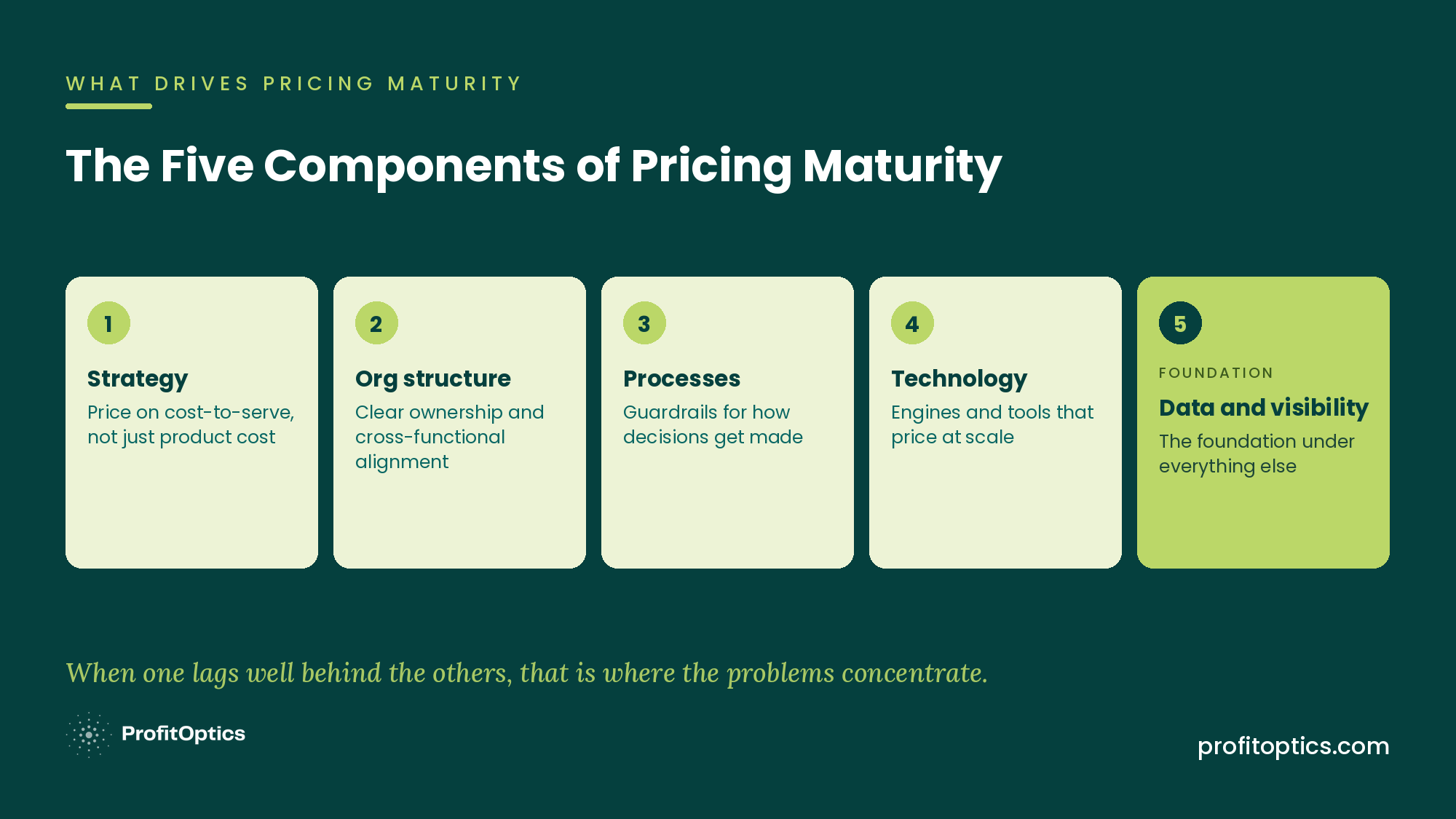
When one of these lags well behind the others, that is usually where the problems concentrate. A company can have a sophisticated pricing engine and still lose margin every quarter because nobody owns the decision or because the underlying data cannot be trusted.
Read: The 5 Execution Gaps Behind Most B2B Pricing Breakdowns
This model is not meant to label your company as one thing or another. Most distributors will have areas that are mature and areas that are still highly manual. Read the levels below looking for the parts that sound familiar, not for the box you fit in.
You might be here if:
What matters at this stage: establishing accountability for pricing, creating visibility into profitability and how decisions get made, and reducing dependence on spreadsheets and tribal knowledge.
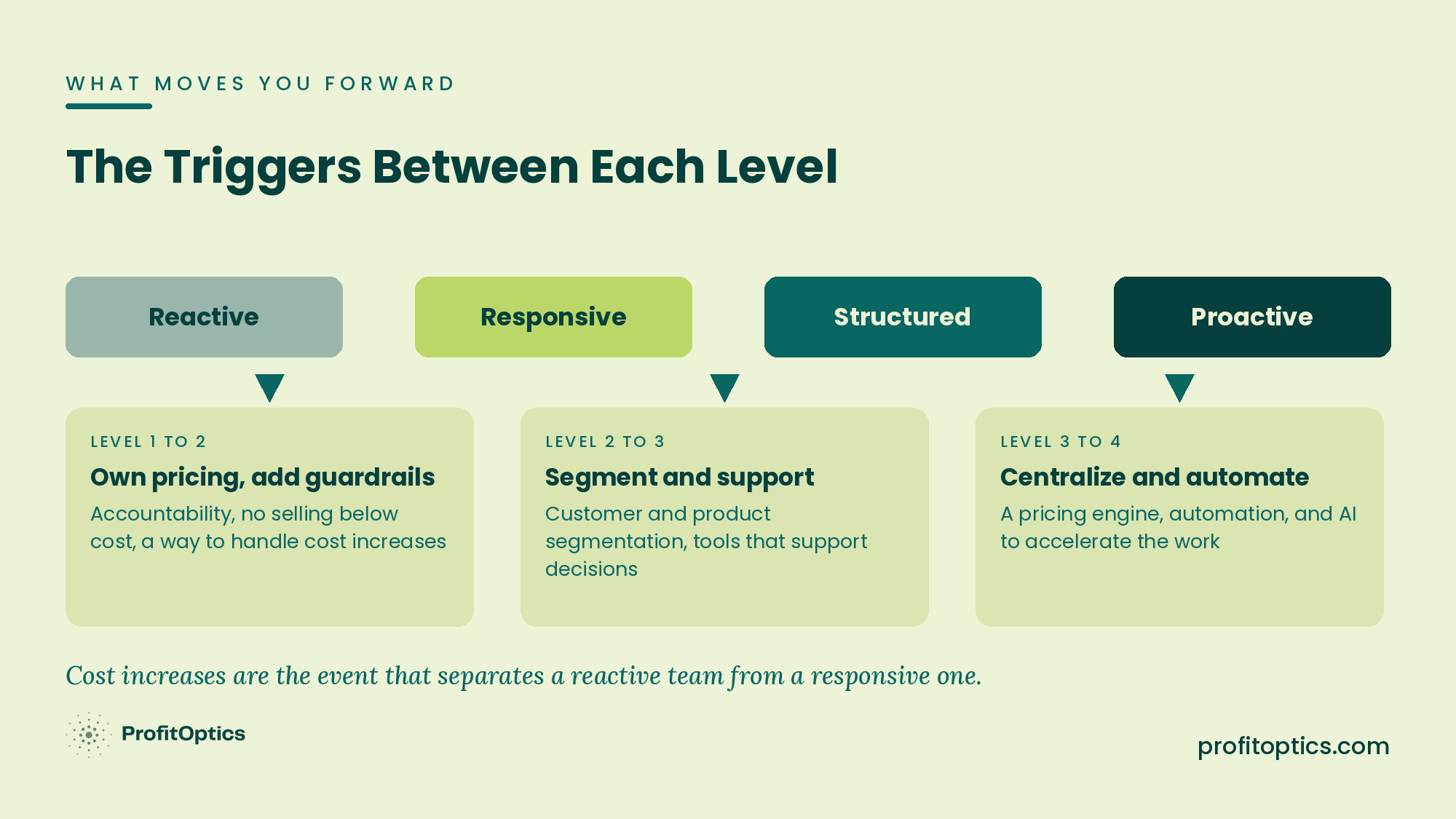
What it takes to move forward: establish clear ownership of pricing, then introduce basic guardrails. No selling below cost. Approval thresholds. A structured way to handle cost increases.
That last one matters more than most teams expect. Cost increases are the single most common event that separates a reactive pricing operation from a responsive one.
Read: Turning Cost Increases into Margin Protection: A Practical Guide for Distributors
You might be here if:
What matters at this stage: creating consistency across teams and regions, improving visibility into customer profitability and pricing performance, and building real alignment between pricing, sales, finance, and operations.
What it takes to move forward: introduce customer and product segmentation, align pricing to customer value and item importance, and begin implementing tools that support decisions rather than replace them.
The hard part at this level is not building guardrails. It is building guardrails your sales team will actually use. Guidance that is too tight gets ignored or escalated around, and you end up back where you started.
Read: How Safe Zones Fill the Pricing Execution Gap for Distributors and Manufacturers
You might be here if:
What matters at this stage: applying segmentation in a way that actually drives better decisions, improving consistency without slowing the business down, scaling pricing through tools instead of more people, and increasing speed to market in quoting and decision-making.
What it takes to move forward: implement a centralized pricing engine that brings together cost signals, product data, contracts, and customer segmentation. Automate pricing updates where you can. Start bringing AI into the picture, not to make pricing decisions but to accelerate data processing, contract interpretation, and long-tail pricing consistency.
Quoting is the honest test of this level. It is where pricing strategy meets real customer behavior, and it exposes every weakness in the process behind it.
Read: Why Quoting Exposes Every Weakness in Your Pricing Strategy and Lessons You Only Learn After Leading Pricing Software Implementations
You might be here if:
What matters at this stage: maintaining accuracy and trust in automated decisions, managing by exception rather than by transaction, keeping systems integrated and responsive, applying AI and automation where scale demands it, and sustaining performance as the business grows.
Level 4 is not a finish line. It is a different set of problems. The work shifts from making decisions to maintaining trust in the decisions your systems are making for you.
Sit down with your team and talk about how pricing actually works today. Not how it is documented. How it looks in the field, in quoting, and under pressure. These questions are designed to start that conversation.
Reality check. If someone asked you tomorrow why margin changed last quarter, how confident would you be in your answer?
If the honest answer is "we would need a week and a few spreadsheets," that is a data and visibility gap, and it is usually the first thing worth fixing.
Read: The Truth About Your Business Problems: It's the Data
A lot of distributors expect AI to step in and fix pricing by setting prices automatically, optimizing margin, and eliminating manual work. AI cannot replace the fundamentals. It is built on top of them.
AI earns its keep where scale, speed, and complexity exceed what people can reasonably manage:
That first one is not theoretical. One $12B distributor was taking three to four weeks to turn around competitive quotes, with accuracy stuck around 70 to 80 percent, because fragmented product data and inconsistent rules across divisions made every bid a manual reconciliation exercise. Automating the conversion process brought turnaround under two days and pushed accuracy above 90 percent.
Read: How a $12B+ Distributor Cut Quote Cycle Times in Half With Conversion Automation
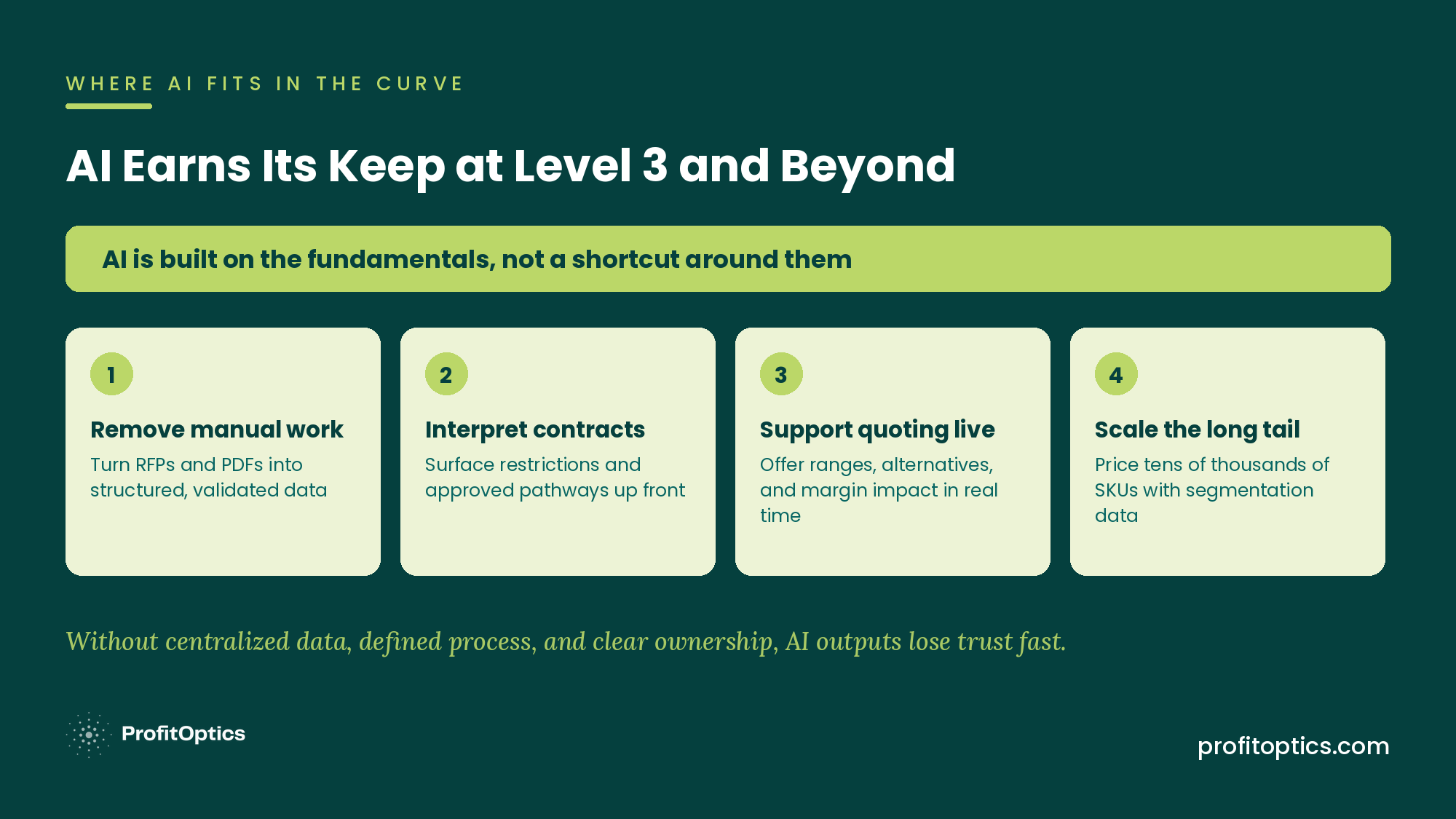
Notice that every one of those applications shows up at Level 3 or later. Before AI can deliver meaningful value you need centralized data, defined processes, clear ownership, and an established pricing strategy. Without those, recommendations lack context, outputs are inconsistent, and trust in the system breaks down fast.
Read: How Distributors Can Build a Data Foundation for AI Readiness
Pricing touches nearly every part of a distribution business. And unlike most initiatives that take quarters or years to move the numbers, pricing decisions can affect revenue and profitability almost immediately. That is the argument for starting here.
Yet plenty of distributors still manage pricing reactively, leaning on disconnected processes, limited visibility, and individual experience to make decisions that carry real financial weight.
The companies that make the biggest gains are not the ones that jump straight to the most advanced tools. They are the ones that understand where they are today, establish the right foundations, and build capability over time.
No matter where you land on the curve, the next step is the same. Identify the gaps that are limiting performance and focus on the improvements that will create the greatest business impact.
If this framework is useful, you may also want to look at how the same pattern plays out on the rebate side of the business.
Read: The Rebate Maturity Model: Understanding How Rebate Operations Really Scale
Not sure where your pricing organization stands? A pricing maturity assessment will show you where your greatest opportunities are today and what it will take to reach the next level. Reach out today for a call.