August 7, 2026




In this article, I cover one of the most important concepts in master data management: the Golden Record. Here’s what you’ll learn:
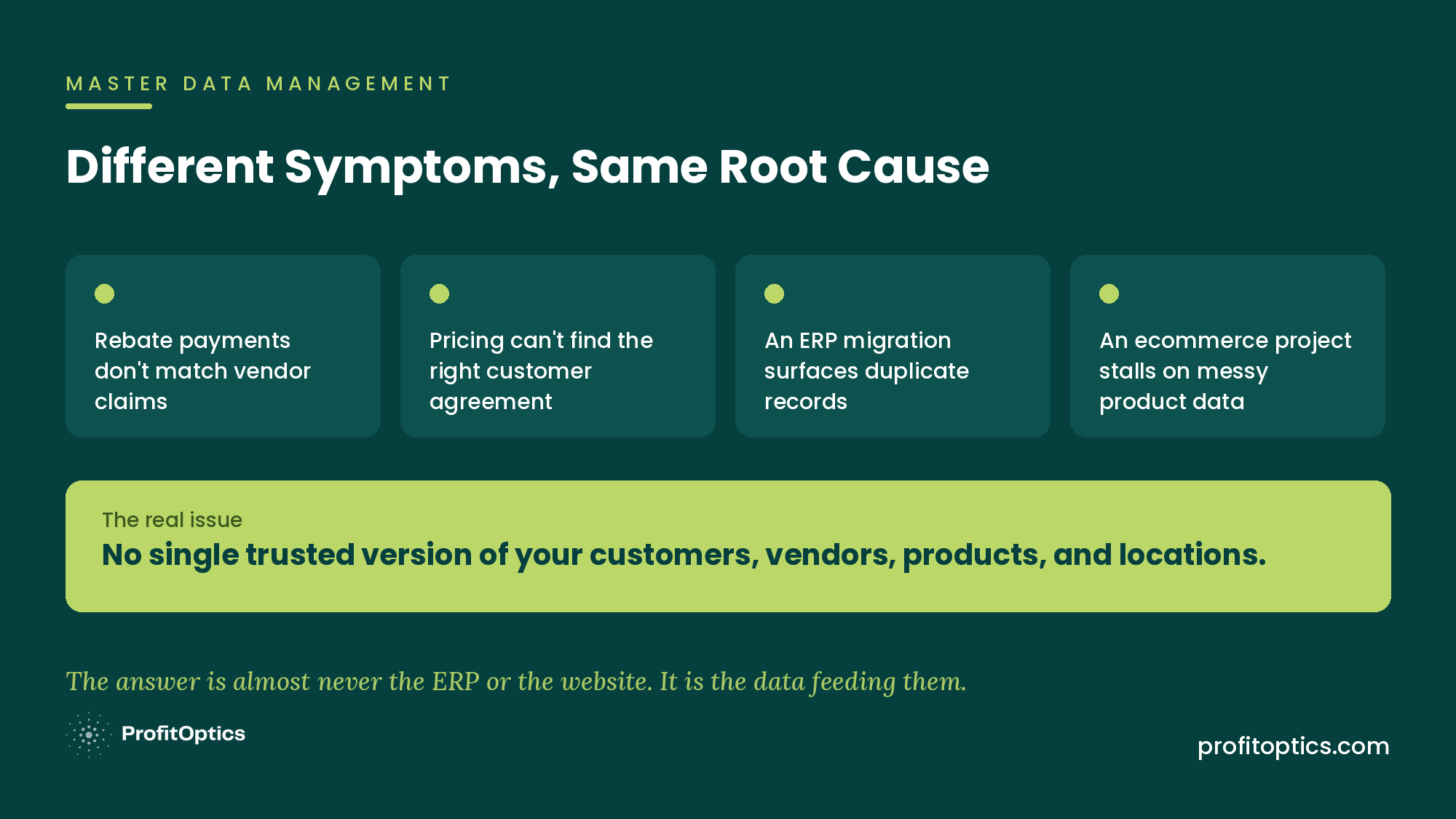
Rebate payments aren't matching vendor claims. Pricing teams can't confidently identify the correct customer agreement. An ERP migration is uncovering duplicate customer records. Or an ecommerce project stalls because product data isn't structured consistently across systems.
On the surface, these all look like unrelated challenges. But they are often symptoms of the same underlying issue:
The business doesn’t have a single, trusted version of its customers, vendors, products, or locations.
I spent years leading data and analytics inside a large distributor before I started doing this work for others. I have sat in the seat where the product duplicates cause real-world issues, and nobody can say why. The answer was almost never the ERP or ecommerce site itself; it was the master data feeding it.
The cost is not abstract. Some organizations have armies of people to fix it. Others outsource to low-cost regions. But that’s just trying to outrun the problem that never stops. It eventually becomes a number a CFO feels.
Every major operational initiative depends on trusted master data. The keyword here is “trusted.” The goal of master data management is one trusted version of each core business entity.
A customer.
A vendor.
A product.
A location.
One record every system can reference with confidence. We call it the Golden Record.
It sounds straightforward. Just pick the best one. Right?
It is one of the hardest data problems a distributor faces, because every system holds its own version of the same thing and none of them holds the whole picture.
Most distributors carry hundreds of thousands of customer, vendor, and product records. Often millions. They sit across multiple ERP systems, CRM platforms, ecommerce applications, acquisitions, and catalogs. Every system stores information a little differently.
Picture an ERP migration. The legacy system holds three versions of one customer, created over 15 years. Before you migrate, someone has to decide what the new system inherits. Skip the Golden Record step and the migration just gives bad data a nicer home, and most of the time, it’s actually made the problem worse by taking fragments of the original, breaking links up and down stream in other systems.
Now imagine you acquire another company. You’ve both sold to many of the same customers for years, but have both maintained your own ERP, CRM, pricing system, and product database. One system stores a customer as "ABC Manufacturing." Another uses "ABC Manufacturing, Inc." A third abbreviates the name entirely: “ABC.” Each record contains different addresses, contacts, transaction history, pricing agreements, and credit information.
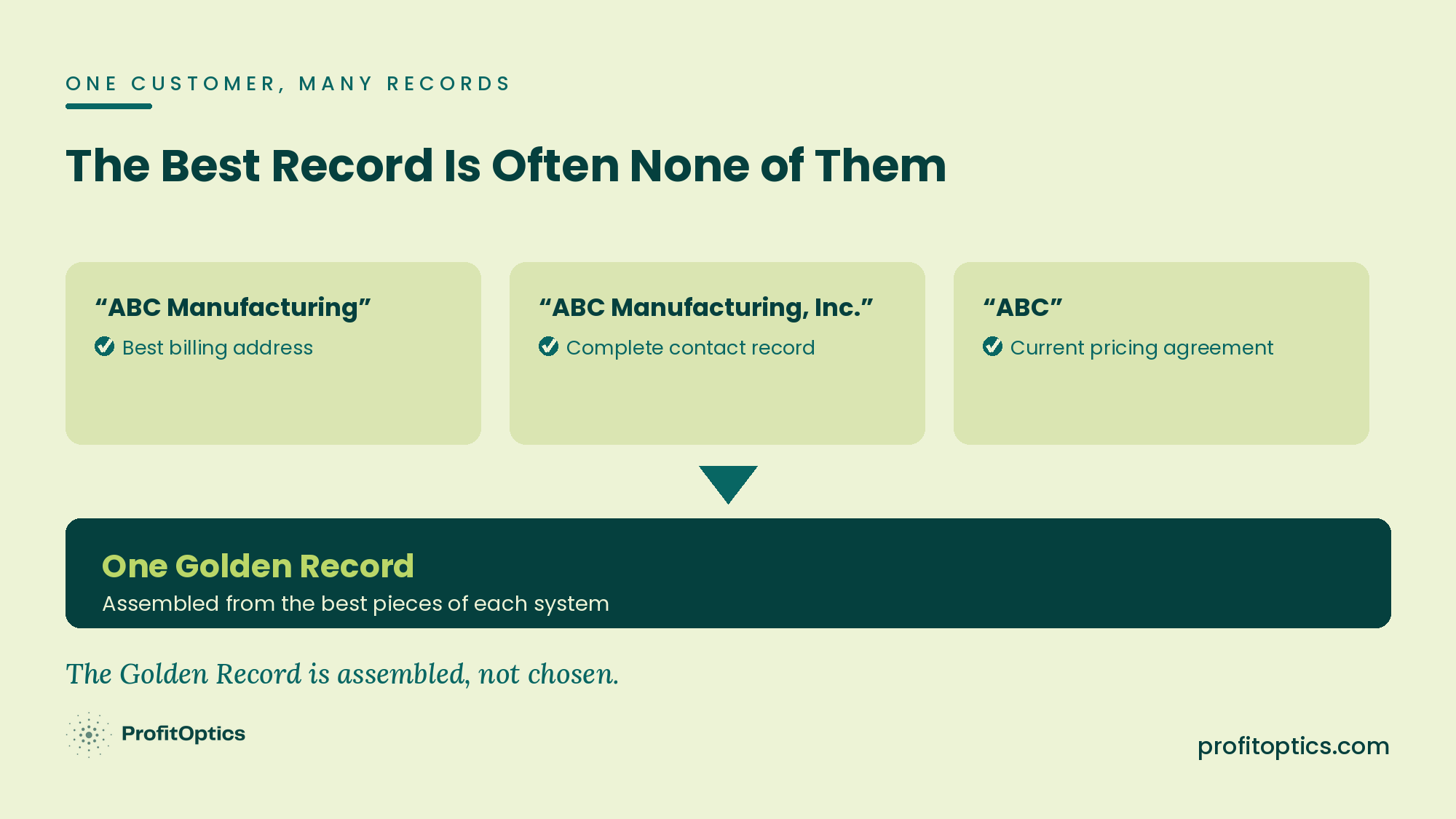
In both cases, the records clearly represent the same customer. The challenge is determining what your single, trusted record should look like.
Here is the part people miss. Sometimes the right record is none of the existing ones. The best customer record gets assembled from pieces: the correct billing address from one system, the complete contact from another, the current pricing agreement from a third.
You don’t need better matching software to create a Golden Record. That’s one component, yes. But more importantly, you need a repeatable process for identifying, validating, and maintaining trusted master data.
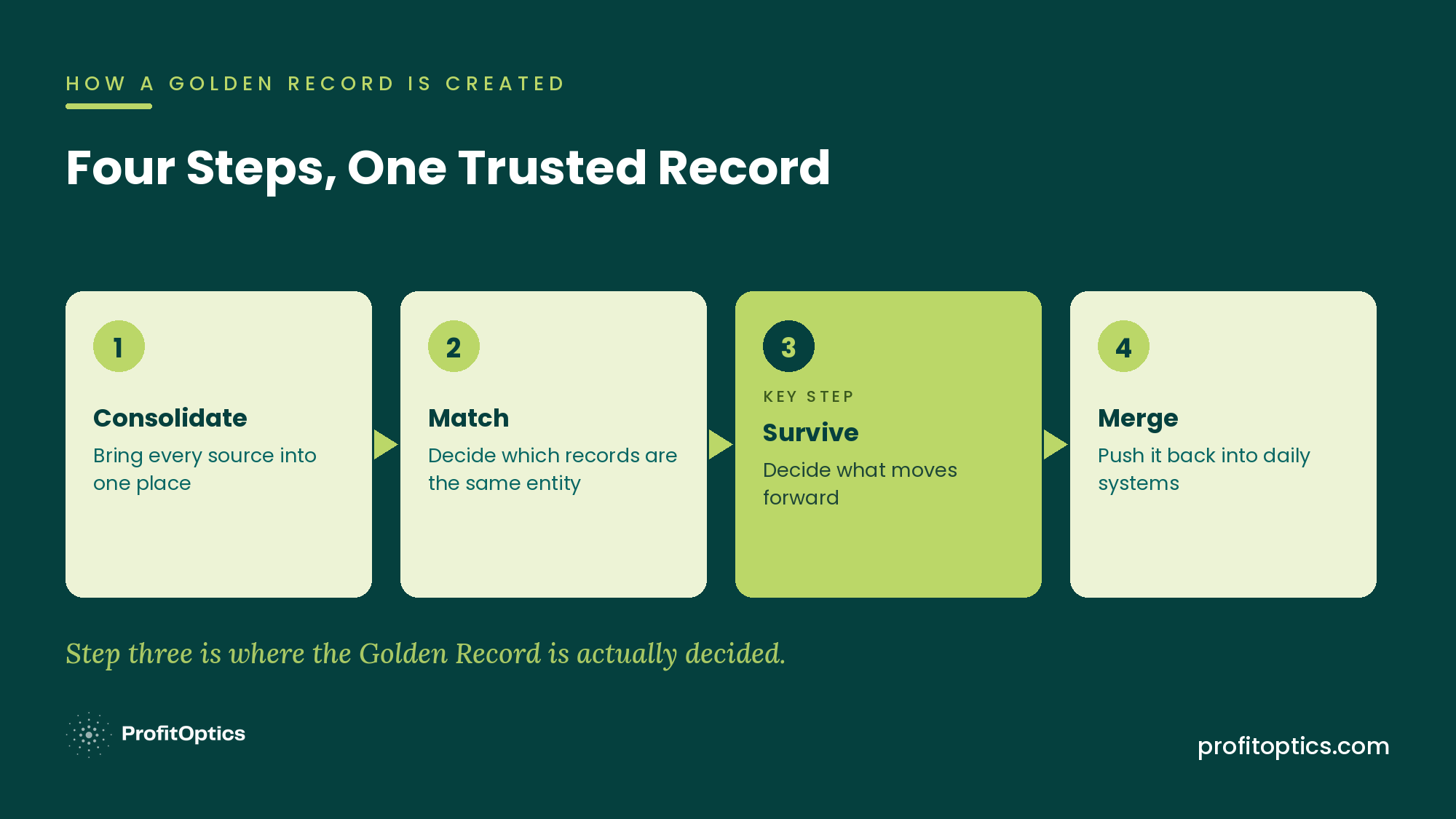
Our process follows four steps. It’s in the third step where you decide what will move forward as your Golden Record.
1. Consolidate
Bring all the data into one place: every ERP, CRM, ecommerce app, acquired business, and catalog.
2. Match
Decide which records represent the same entity. Technology is very good at this now, but no distributor should expect it to be fully automatic. There are always records that require an off-ramp, a point where a person reviews uncertain matches instead of allowing automation to make the decision.
3. Survive
This is where you decide what moves forward. The Golden Record is usually assembled from the best available information across multiple systems.
Determining what survives isn't just a technical decision. It requires business rules. Which system of record is considered the system of record for customer addresses? Should CRM own contact information or all customer data? Which system contains the most reliable product attributes or pricing relationships? Sometimes the answer isn’t just one! Those decisions determine how the Golden Record is built and ensure every department is working from the same information.
4. Merge
Push the Golden Record back into the systems people use every day. Otherwise, you keep a clean copy in one place while the operational systems keep creating new mess.
Creating a Golden Record isn't the finish line.
Every day, you add new customers, onboard new products, acquire companies, update vendor information, and introduce new systems. Without governance, duplicate and inconsistent data gradually finds its way back into the business.
The causes are often almost silly. I worked with one distributor whose salespeople were measured on creating new customer records. The result was not seven new customers. It was seven versions of the same one. At another company, anyone could spin up a product record to close a sale. You can guess how that snowballed.
These are governance failures.
That's why successful master data initiatives don't end with data cleanup. They establish standards for how new records are created, validated, and maintained so you don’t find yourself solving the same problem again a year later.
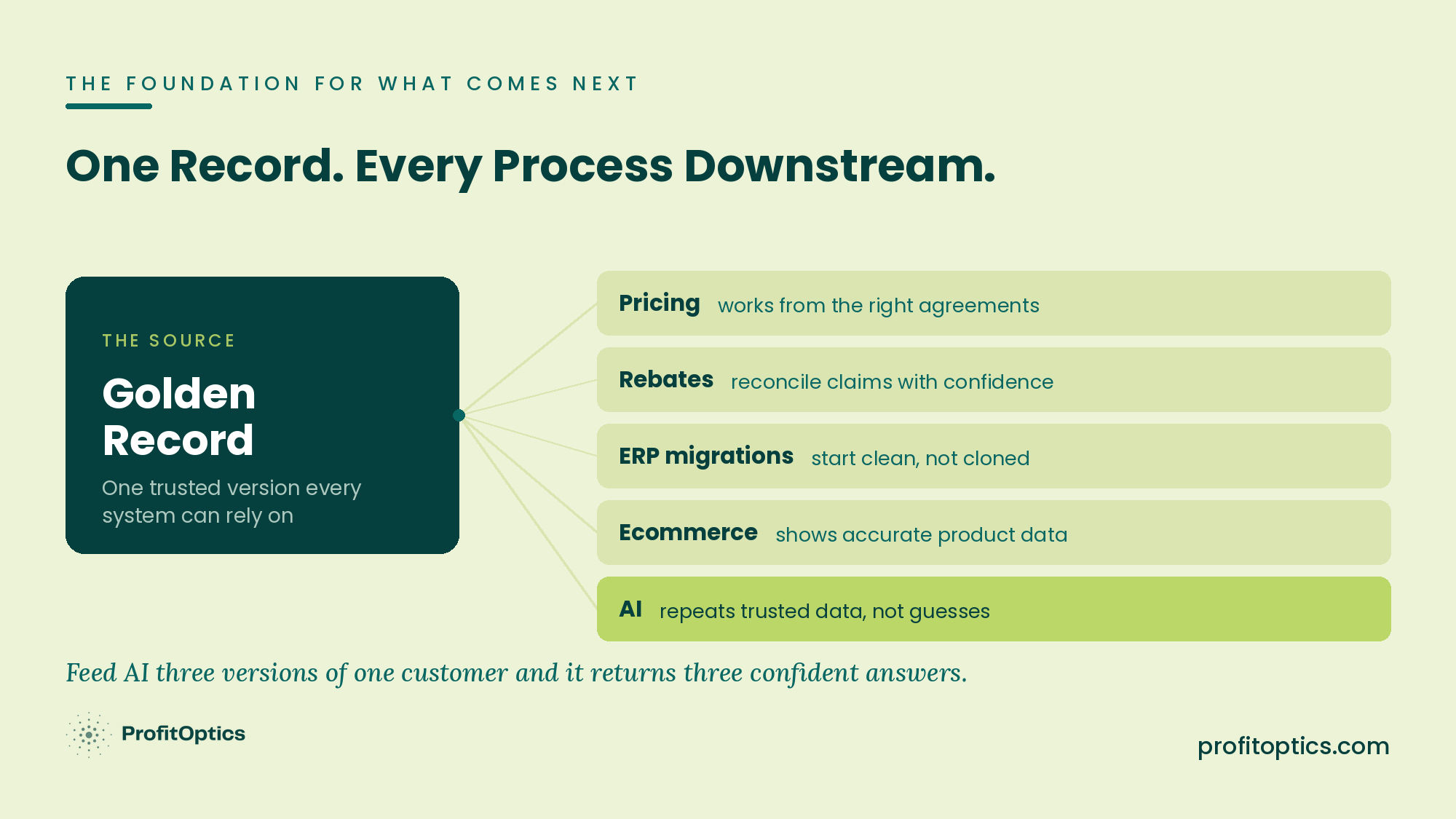
A Golden Record is not valuable because the data is cleaner. It is valuable because every process that touches customer, vendor, or product data starts from the same place.
Pricing teams work from the right agreements. Rebate analysts reconcile claims with confidence. ERP migrations start clean. Ecommerce shows accurate product data. Your people spend less time arguing about the data and more time using it.
AI raises the stakes even further. A model does not fix your data. It repeats it, faster and at scale, with a confident tone. Feed it three versions of one customer, and it will give you three confident answers. The data you own is the one input a competitor cannot copy. It is also the one thing that decides whether your AI work helps you or embarrasses you.
The Golden Record is where that starts.
If you are staring down an ERP migration, an acquisition, or a pricing initiative that keeps hitting bad data, let's talk before you build on the wrong foundation.