October 29, 2026




The short version:
Your rep is talking with a customer and has to decide whether to hold the price or make an exception to protect the business.
But that decision shouldn’t start with the rep.
The information needed to make it may exist across the business, with different teams holding different pieces of the picture. When those pieces aren’t brought together, the rep ends up making the call based largely on what they believe the customer will tolerate.
Sales should have judgement and flexibility, but they shouldn’t have to reconstruct the company’s pricing strategy every time they quote a customer. If trust and gut instinct are filling information gaps, trace the pricing decision backward:
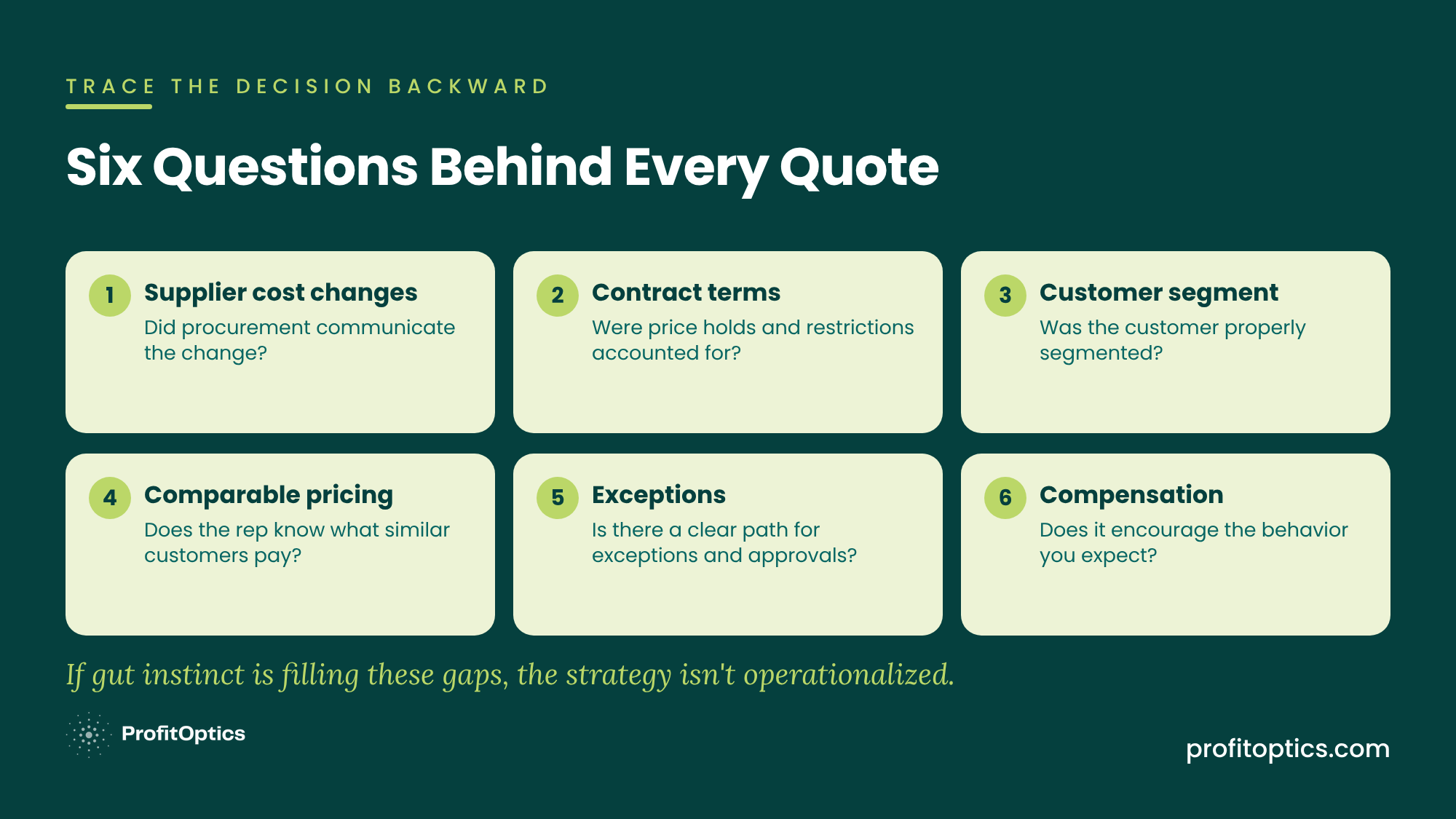
An individual rep can’t be expected to keep track of every pricing rule, cost change, customer or product protection, contract requirement, and rebate consideration.
If that’s what execution requires, you haven’t operationalized your pricing strategy.
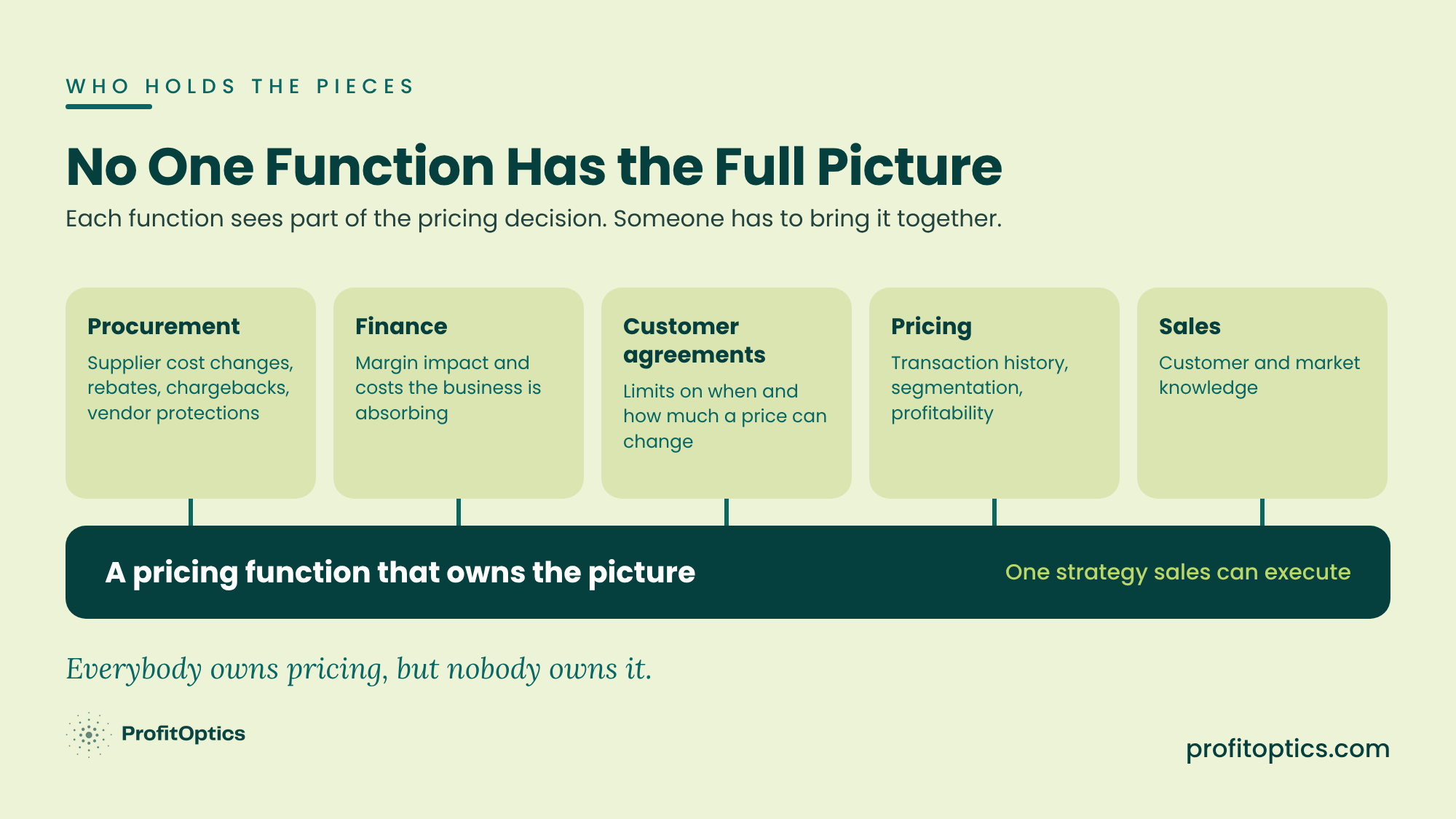
The price a sales rep presents to a customer reflects information from across the business.
Procurement or merchandising may know that a supplier cost change is coming, along with any rebates, chargebacks, or vendor protections that could offset it.
Finance sees the effect on margin and where the business is absorbing costs it expected to recover.
Customer agreements limit when and how much a price can change.
Pricing brings in transaction history, customer and product segmentation, profitability, and other factors to determine where prices should move.
Combined with sales reps’ knowledge of the customers and market, each of these pieces is important. But no one function has the full picture. A department can make a reasonable decision based on the information it has and still contribute to the wrong pricing decision for the business. A supplier increase, for example, may look like it needs to be passed through until someone identifies a rebate that offsets it or a customer agreement that prevents the increase altogether.
Take fuel costs. A jump in fuel may start with supply chain, but recovering that cost quickly becomes a pricing decision. Contracts may restrict what can change. Pricing needs to determine which customers are exposed and how much can be recovered. Sales still has to manage the customer conversation, but needs additional input to decide whether to add a surcharge, absorb the cost, or change the price.
Those choices should already be shaped by whoever owns pricing before they reach the rep. I’ve seen distributors reach a point where everybody owns pricing, but nobody owns it. Information and responsibility are spread across the business, but there isn’t a pricing function bringing those pieces together.
As a distributor grows, pricing needs to become a more defined function. That could mean building a pricing center of excellence from existing employees, adding dedicated pricing talent, or both. At a certain scale, one person can’t manage it all.
Whatever the structure, ownership can’t remain scattered.
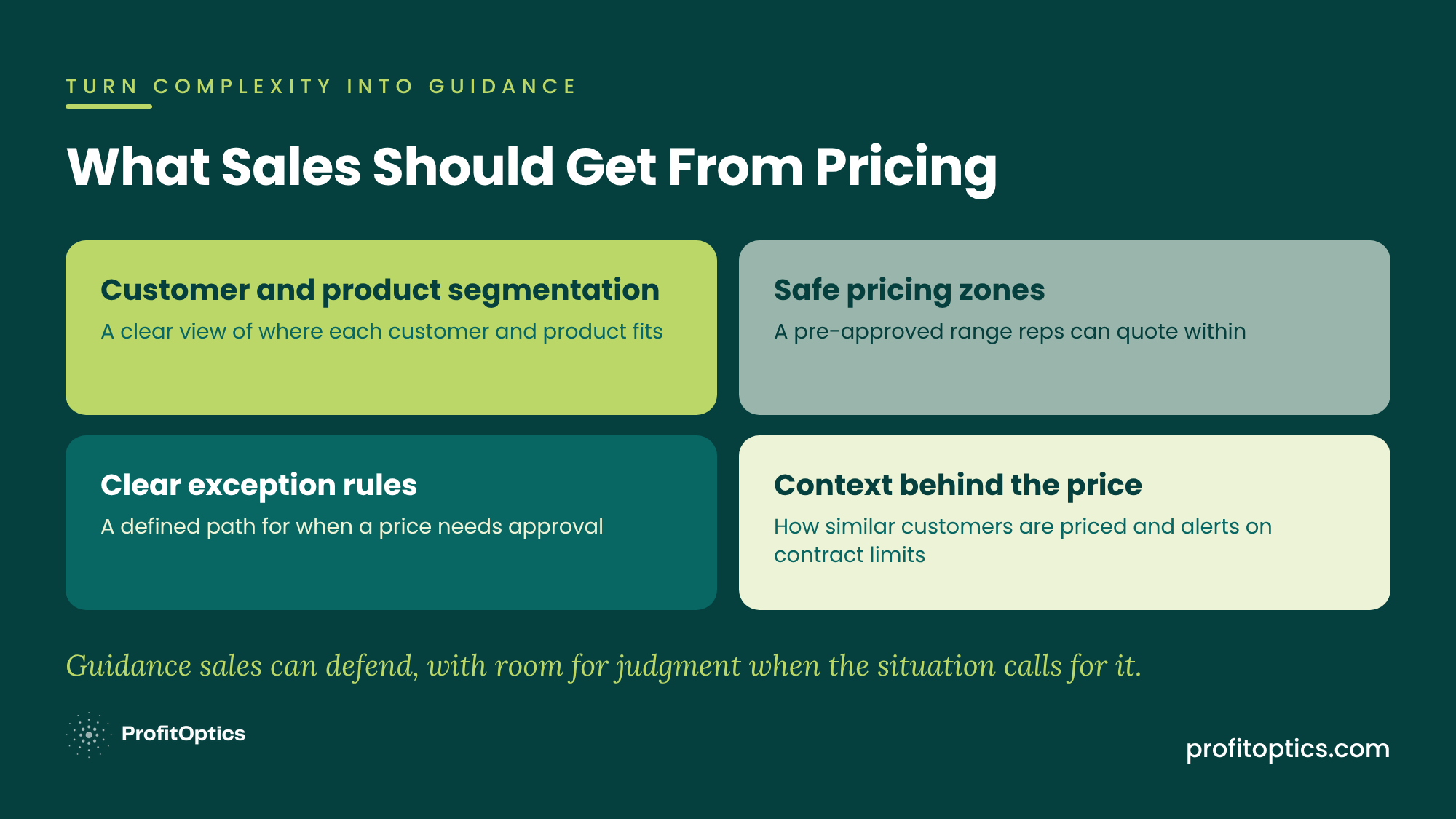
The pricing function is responsible for turning inputs from across the business into a strategy that can be executed: establishing rules and guardrails, making sure the right information feeds into pricing decisions, and giving sales clear guidance they can use with customers.
That might include:
A rep may also need to see how similar customers are priced or receive an alert when a contractual restriction limits a price change. Sales needs enough context to understand why the guidance makes sense, defend the price in a customer conversation, and recognize when circumstances justify a different decision.
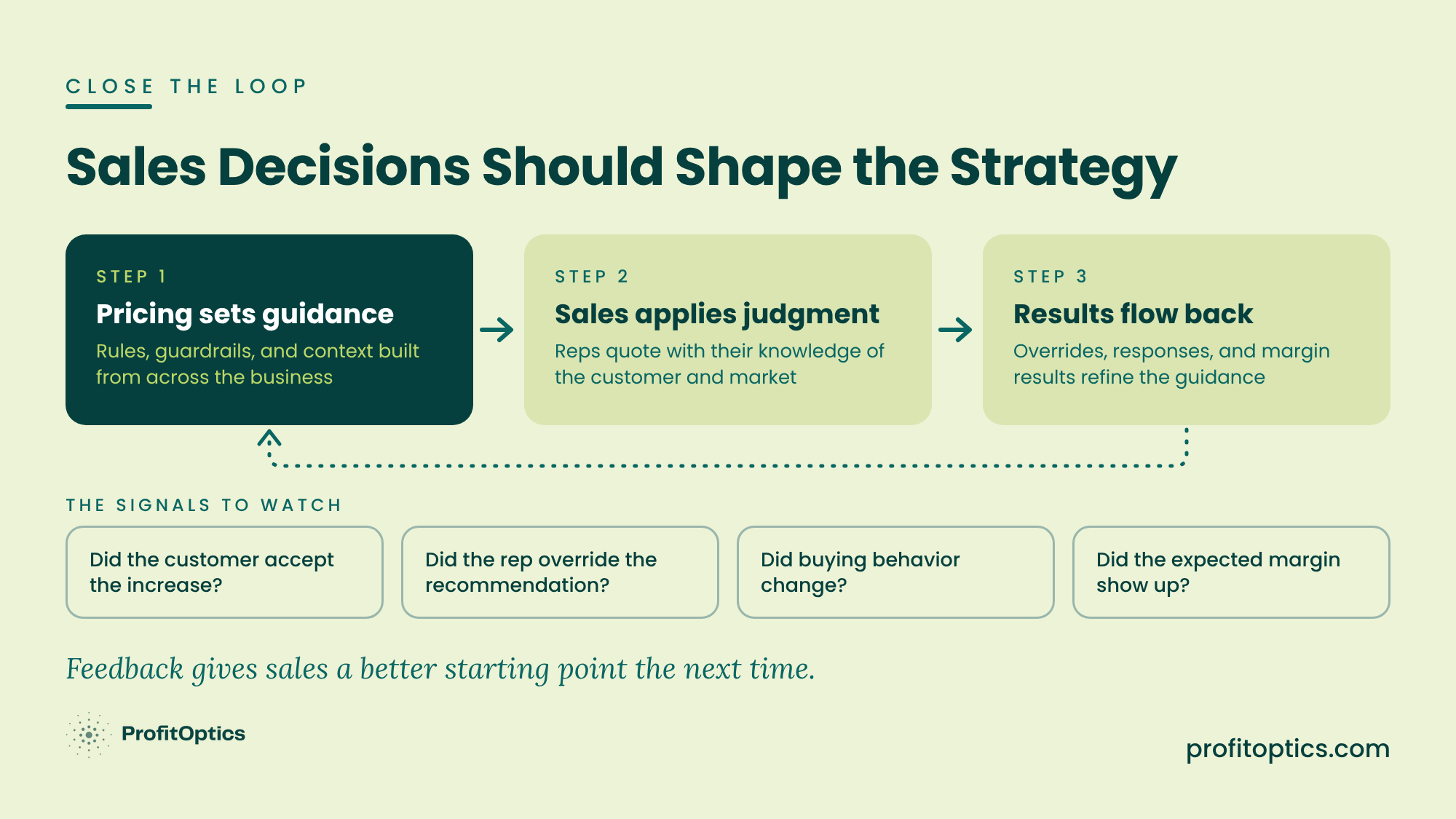
Taking ownership of pricing doesn’t mean taking sales out of the process. Reps bring customer and market knowledge that should inform the strategy, and the results of their pricing decisions provide valuable feedback. Did the customer accept the increase? Did the rep override the recommendation? Did buying behavior change? Did the expected margin improvement show up?
That information should flow back to whoever owns pricing. Patterns in overrides, customer responses, and margin results can show where the guidance needs to change. That feedback gives whoever owns pricing a clearer picture of where to refine the strategy and gives sales a better starting point the next time.
“Everybody owns pricing” can quickly become “every sales rep owns the price.” That’s asking a lot for the front line of your business to carry that responsibility.
Clear ownership gives sales a different starting point. Instead of piecing together the pricing strategy one quote at a time, reps can work from guidance that already accounts for the factors the business has decided should influence price, while still applying their knowledge of the customer and the situation.
Clear ownership also requires a way to put the pricing strategy into practice across thousands of customer and product decisions. ProfitOptics brings pricing data, rules, customer and product segmentation, safe zones, approvals, and other pricing workflows together so the people responsible for pricing can turn strategy into guidance sales can use.
The result isn’t less judgment by sales reps. It’s clearer responsibility behind the decisions sales reps are being asked to make.
Pricing should sit with a dedicated pricing function, whether that is a center of excellence built from existing staff or dedicated pricing talent. That function brings together cost changes, contracts, customer data, and margin targets, then turns them into guidance sales reps can use. When no one owns pricing, responsibility spreads across departments and ends up resting on whatever the rep decides in the moment.
A pricing center of excellence is a dedicated group, or in some cases a single role, that owns the pricing function for a growing distributor or manufacturer. It pulls in inputs from purchasing, finance, customer agreements, and sales, then turns them into pricing rules, guardrails, and guidance the sales team can execute with customers.
Safe pricing zones give reps a pre-approved range they can quote within, based on customer and product segmentation, without needing a one-off approval. These guardrails give sales room to use their judgment on a specific customer while keeping every quote within limits the business has already decided make sense.
Procurement, finance, and sales each see a piece of the pricing picture, but none of them sees the whole thing. Without a function pulling those pieces together, a supplier cost increase might get passed through in full, even when a rebate or customer agreement should have changed the outcome. Reps end up filling the gap with instinct instead of strategy.
ProfitOptics is a team of practitioners and engineers who help distributors and manufacturers own the systems that decide their margin: pricing, rebate, and quoting software. We build that software into whatever you’re already running, so it fits your business instead of a vendor’s business model, and you don’t pay for features you’ll never use. If you’re still running the real work on a spreadsheet, that’s not on you, it’s on every system that asked you to trust it and never earned it. Our roots are in running pricing, data, and operations inside distribution businesses, not learning the industry on a client’s clock. Hire us, and your software stops being a line item and starts being an asset: something that compounds, not depreciates.